
Short answer
An SSD's working life is bounded by how much is written to it, not by calendar years. Makers publish either a TBW figure — the total terabytes a host may write — or a DWPD figure, the number of times the drive's full capacity may be written each day across the warranty term. The two convert: TBW = DWPD x capacity in TB x 365 x warranty years.
Key facts
- JEDEC JESD218 expresses an SSD endurance rating as terabytes written (TBW) by the host, per application class.
- JESD218 defines two application classes, Client and Enterprise, each with its own conditions of use and verification requirements.
- The workloads a drive is measured against are defined separately, in JEDEC JESD219.
- Micron describes DWPD as the share of capacity writable per day: a 1 TB drive at 0.3 DWPD accepts about 300 GB a day.
- TBW = DWPD x capacity in TB x 365 x warranty years — a 1.92 TB drive at 1 DWPD over five years is about 3,500 TB.
- A DWPD number without its warranty term is not comparable: 1 DWPD over five years is far more writing than 1 DWPD over three.
By Uniqcli Team
An SSD does not wear out on a calendar. It wears out on writes, because every program-erase cycle degrades the NAND cells a little, and a drive's rated life is expressed as an amount of data written rather than a number of years in service. That is why two identical-looking drives can carry endurance ratings an order of magnitude apart.
Manufacturers publish that rating one of two ways. TBW is terabytes written — the total a host may write over the drive's warranted life. DWPD is drive writes per day — how many times the drive's full capacity may be written every day for the length of the warranty. They describe the same number from different ends, and they convert cleanly.
JEDEC standardized the measurement so the numbers can be compared. JESD218 defines an SSD endurance rating expressed as terabytes written by the host, per application class, and JESD219 defines the workloads a drive is measured against — which is what stops a vendor from quoting an endurance figure from a workload nobody runs.
TBW and DWPD: the same rating from two ends
TBW is the plain total: write this many terabytes and you have used the warranted life. DWPD normalizes that total against capacity and time, so a bigger drive at the same DWPD carries a bigger TBW. Micron puts DWPD in useful terms — it is the share of the drive's capacity that can be written each day, so a 1 TB drive rated 0.3 DWPD accepts about 300 GB a day.
The conversion is arithmetic: TBW = DWPD x capacity in TB x 365 x warranty years. A 1.92 TB drive rated 1 DWPD on a five-year term gives 1 x 1.92 x 365 x 5, or about 3,500 TB. If a datasheet's DWPD and TBW figures do not reconcile against each other, the warranty term is usually the missing variable — read all three off the datasheet rather than assuming a term.
This is also why DWPD without a warranty term is meaningless. One DWPD on a three-year drive and one DWPD on a five-year drive are different amounts of writing, and the second drive is the more durable one at the same headline figure.
Where the endurance tiers come from
JESD218 defines two application classes — Client and Enterprise — each with its own conditions of use and endurance verification requirements. That split is why a consumer-class drive and a data-center drive with the same capacity are not interchangeable on paper: they were verified against different assumptions about duty cycle, temperature and retention.
Within the enterprise class, vendors sell tiers by intended workload. Read-intensive drives sit around a fraction of a drive write per day and suit boot volumes, media libraries and analytics that mostly read. Mixed-use drives sit at one to a few drive writes per day and suit virtualization, databases and anything with a heavy log. Write-intensive drives sit higher again and are the specialist end.
Buying up a tier costs money for endurance that is never consumed; buying down a tier retires the drive early. The point of measuring first is that most fleets discover they are one tier over-specified.
How to size endurance for a real workload
Measure the daily write volume on the system the drive is replacing, over a period long enough to include the backup window and month-end. Divide by the drive capacity you intend to buy to get the drive writes per day the workload actually generates, then add margin for growth and for write amplification — the internal writes the drive performs on top of the host's, which is why the drive's own counter always exceeds what the operating system reports.
Then read the rating you need off the datasheet rather than the marketing tier name. A drive rated 0.7 DWPD on a five-year term covers a workload writing half its capacity a day with room to spare; the same workload on a 0.3 DWPD drive exhausts the rating before the warranty ends.
Checking how much life a drive has used
Both SATA and NVMe drives report wear through their own telemetry: SMART attributes on SATA, the SMART/Health Information log on NVMe. The two fields that matter are the percentage-used indicator and the data-units-written counter, which together tell you how much of the rated endurance is gone and how fast it is going. Vendor tools read them; so do the standard command-line utilities on Linux and Windows.
Treat percentage used as a planning signal rather than a failure alarm. A drive at 60 percent of its rating after two years of a five-year deployment is telling you the refresh will be needed early, which is a budget conversation rather than an emergency — and far better than discovering it from a monitoring page after the drive has gone read-only.
Key takeaways
- An SSD's life is bounded by data written, not by years in service — the rating is an amount of writing.
- TBW is total terabytes a host may write; DWPD is how many times the full capacity may be written per day across the warranty term.
- Convert with TBW = DWPD x capacity in TB x 365 x warranty years; a DWPD figure without a warranty term is meaningless.
- JEDEC JESD218 expresses SSD endurance as TBW per application class, with Client and Enterprise defined separately.
- Enterprise tiers run from read-intensive through mixed-use to write-intensive; most fleets are a tier over-specified.
- Measure the workload's real daily writes, allow for write amplification, then read the required rating off the datasheet.
- SMART and the NVMe health log report percentage used and data units written — use them for refresh planning, not just alarms.
Shop it at Uniqcli
Parts for this job
Mixed use
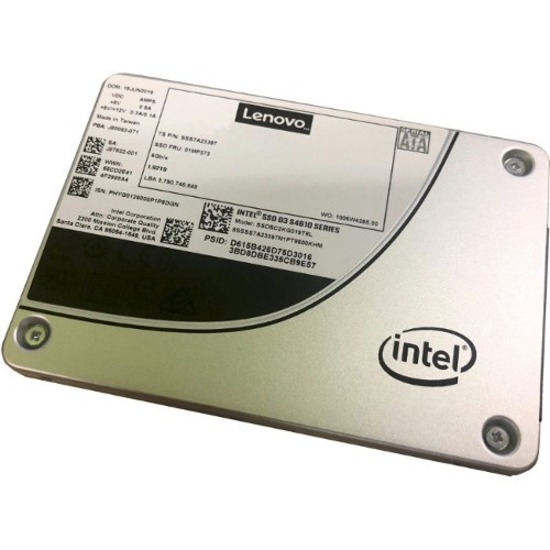
Lenovo
Lenovo D3-S4610 480 GB Solid State Drive
4XB7A13933
Lenovo D3-S4610 480 GB SATA SSD rated 3.4 drive writes per day and 3,072 TB written — the endurance tier for virtualization hosts and write-heavy databases.
$351.35Back-orderedRead intensive
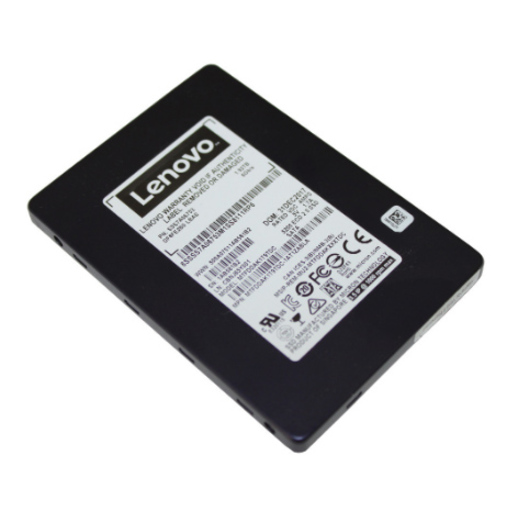
Lenovo
Lenovo 5200 480 GB Solid State Drive
4XB7A14050
Lenovo 5200 480 GB SATA SSD rated 0.7 drive writes per day and 610 TB written, in a 3.5-inch carrier — sized for boot volumes and mostly-read data sets.
$390.89Back-orderedNVMe, mixed use
Dataram
Dataram EC500 EC500S8NP 960 GB Rugged Solid State Drive
EC500S8NP/960G
Dataram EC500 960 GB PCIe NVMe SSD rated 2.00 drive writes per day and 2,102 TB written, with a five-year warranty and 256-bit encryption support.
$316.75Back-orderedFrequently asked
- How many years will an SSD last?
- There is no honest answer in years alone, because the rating is an amount of writing rather than a span of time. A drive rated 1 DWPD on a five-year warranty lasts five years if you write its full capacity every single day, and much longer if you do not. Measure the daily write volume of the workload, divide by the drive capacity, and compare the result against the drive's DWPD rating.
- What is the disadvantage of SSD?
- The main one is finite write endurance: NAND cells degrade with each program-erase cycle, so an SSD has a rated amount of writing rather than an open-ended life, and the rating varies widely between a client drive and an enterprise mixed-use drive. Cost per terabyte is also higher than hard disks at the capacities used for bulk and archive storage.
- How long will a QLC SSD last?
- QLC stores four bits per cell and generally carries a lower endurance rating than a TLC drive of the same capacity, which is why QLC parts are usually sold as read-intensive. The answer for any specific drive is on its own datasheet: read the TBW or DWPD figure and the warranty term, then compare them against the workload's measured daily writes rather than against the NAND type.
- How to check TBW on SSD
- Two places. The rated figure is on the manufacturer's datasheet for that exact part number, usually next to the warranty term. The consumed figure is in the drive's own telemetry — SMART attributes on SATA, or the SMART/Health Information log on NVMe, where the percentage-used indicator and the data-units-written counter show how much of the rating has been spent.
Sources
Keep reading