
Short answer
Wi-Fi 6E is Wi-Fi 6 — IEEE 802.11ax — extended into the 6 GHz band. In the United States the FCC opened 1,200 megahertz at 5.925 to 7.125 GHz for unlicensed use, which the Wi-Fi Alliance says adds 14 more 80 MHz channels or 7 more 160 MHz channels. The radio features do not change; the spectrum does, and both the access point and the client need a 6 GHz radio.
Key facts
- The FCC's 2020 Report and Order made 1,200 megahertz of spectrum at 5.925 to 7.125 GHz available for unlicensed use.
- The Wi-Fi Alliance counts 14 additional 80 MHz channels and 7 additional 160 MHz channels in the 6 GHz band.
- The FCC authorized two device classes: standard-power access points under automated frequency coordination, and low-power indoor access points.
- FCC maximum EIRP: 36 dBm for a standard-power access point and 30 dBm for its clients; 30 dBm for a low-power indoor access point and 24 dBm for its clients.
- Wi-Fi 6E is certified as an option within Wi-Fi CERTIFIED 6, so it carries the Wi-Fi 6 feature set plus 6 GHz.
- Wi-Fi 7, a separate certification, is what brings 320 MHz channels to the same 6 GHz band.
By Uniqcli Team
Wi-Fi 6E is Wi-Fi 6 — the IEEE 802.11ax generation — extended into the 6 GHz band. The Wi-Fi Alliance is explicit about the relationship: Wi-Fi 6E brings the features and capabilities of Wi-Fi 6, extended into 6 GHz. The radio techniques are the same ones already in Wi-Fi 6. What is new is where they are allowed to run.
In the United States, the FCC's 2020 Report and Order made 1,200 megahertz of spectrum at 5.925 to 7.125 GHz available for unlicensed use. The Wi-Fi Alliance describes what that buys a network: 14 additional 80 MHz channels or 7 additional 160 MHz channels, in contiguous blocks rather than the fragmented allocations the 5 GHz band has accumulated.
The practical consequence is that 6E is a capacity decision, not a speed decision. A single client on an idle 5 GHz network will not go faster because the access point also has 6 GHz radios. A dense floor of clients competing for the same 5 GHz channels will, because there is somewhere else for them to go.
What Wi-Fi 6E adds, and what it does not
What it adds is spectrum and the clean start that comes with it. The 6 GHz band has no legacy Wi-Fi clients in it: no 802.11b, no 802.11n, nothing that forces an access point to spend airtime on protection mechanisms for devices that predate the current standard. Every device on the band is at least Wi-Fi 6, which is why the wide 160 MHz channels the Wi-Fi Alliance lists are usable there in a way they rarely are at 5 GHz.
What it does not add is a new radio. Wi-Fi 6E is certified as an option within Wi-Fi CERTIFIED 6, so the modulation, OFDMA, MU-MIMO and WPA3 requirements are the Wi-Fi 6 ones. A vendor claiming a fundamentally faster air interface is describing Wi-Fi 7, which is a different certification with 320 MHz channels in the same band.
Standard-power and low-power indoor: the rules that shape coverage
The FCC authorized two classes of unlicensed 6 GHz device. Standard-power access points operate under the control of an automated frequency coordination (AFC) system, which checks a database of incumbent licensed links before granting a channel and power level; those access points can be deployed indoors or outdoors. Low-power indoor access points operate across the whole band without AFC, but at lower power and indoors only.
The power ceilings are what a coverage plan has to work from, and the FCC sets them per device class rather than per band. Its table allows a standard-power access point 36 dBm EIRP and the clients associated with it 30 dBm; a low-power indoor access point is allowed 30 dBm and its clients 24 dBm. Because 6 GHz signals also attenuate more than 5 GHz ones through the same wall, the cell a 6 GHz radio covers is generally smaller than the 5 GHz cell from the same access point.
For most enterprise deployments this means 6E is an additional radio on a tri-band access point rather than a replacement for the 5 GHz one: 6 GHz carries the capable clients at close range, 5 GHz carries the rest and holds the edge of the cell.
Both ends have to support it
A 6 GHz radio in the ceiling is only half the deployment. The client also has to have a 6 GHz radio, and a large share of the installed base does not — laptops and phones older than the FCC ruling physically cannot see the band. Before a 6E rollout is worth its budget, count how many of the devices on the floor can actually associate at 6 GHz.
Where the fleet is not ready, the usual answer is to buy tri-band access points now and let the client base catch up through the normal refresh cycle, rather than to retrofit radios. On desktops that stay in place for years, a PCIe client card is a reasonable exception, because the machine is not going to be replaced on a laptop's schedule.
What to check before you specify 6E
Confirm the access point is tri-band rather than dual-band with a 6 GHz option, and check the uplink: a tri-band access point can exceed a gigabit of aggregate throughput, so a 2.5 Gigabit Ethernet port is the sensible minimum on the switch side. Check the power draw as well, because tri-band radios generally push an access point into the higher PoE class.
Then confirm the regulatory mode you need. A low-power indoor access point is the simple case and needs nothing extra. A standard-power deployment depends on an AFC service, which is an operational dependency to confirm with the vendor before the order rather than after it.
Key takeaways
- Wi-Fi 6E is Wi-Fi 6 (802.11ax) extended into 6 GHz — the radio features are unchanged, the spectrum is new.
- The FCC made 1,200 megahertz at 5.925 to 7.125 GHz available for unlicensed use in its 2020 Report and Order.
- The Wi-Fi Alliance counts 14 additional 80 MHz channels or 7 additional 160 MHz channels in the band.
- Two device classes exist: standard-power access points under automated frequency coordination, and low-power indoor access points.
- Maximum EIRP is set per device class — 36 dBm for a standard-power access point and 30 dBm for its clients, 30 dBm low-power indoor and 24 dBm for its clients.
- Both ends need a 6 GHz radio; count the clients that can actually use the band before budgeting a rollout.
Shop it at Uniqcli
Parts for this job
Higher capacity

Sophos
Sophos AP6 840E Tri Band Wi-Fi 6E IEEE 802.11ax Wireless Access Point
AP84EU00ZZPCNP
Sophos AP6 840E — tri-band 802.11ax with two 2.5 Gigabit Ethernet ports, for floors where a single uplink and a single radio pair run out of headroom.
Rated at 45 W, so confirm the PoE class the switch port can deliver before installing.
Request pricingFor the client end
StarTech.com
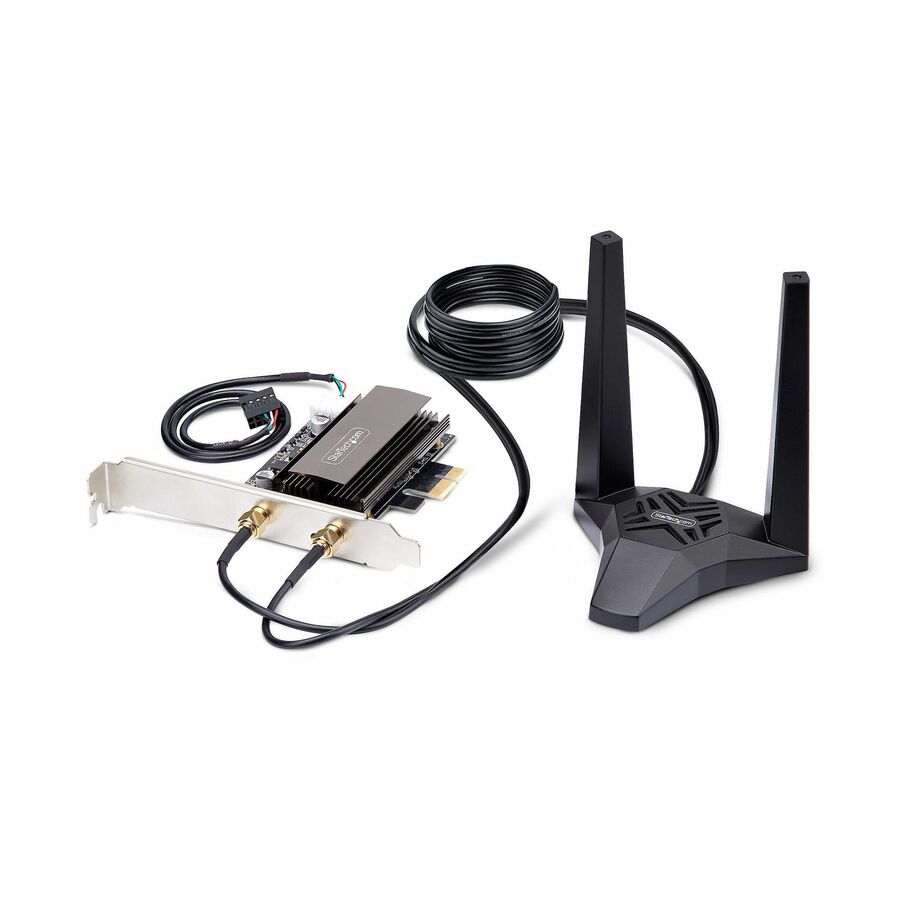
StarTech Wi-Fi 6E PCIe Network Card, Bluetooth 5.3, Magnetic Antenna…
PAX2235-WIFI-6E-CARD
StarTech tri-band Wi-Fi 6E PCIe card with Bluetooth 5.3 and a magnetic antenna base — the way a fixed desktop gains a 6 GHz radio it did not ship with.
$105.61In stockFrequently asked
- Is Wi-Fi 6E the same as Wi-Fi 6?
- It is the same generation with more spectrum. The Wi-Fi Alliance certifies Wi-Fi 6E as an option within Wi-Fi CERTIFIED 6, so the feature set — 802.11ax modulation, OFDMA, MU-MIMO, WPA3 — is the Wi-Fi 6 one. The difference is that a 6E device can also use the 6 GHz band, where no legacy Wi-Fi clients exist and wide channels are actually available.
- How much spectrum did the FCC open in the 6 GHz band?
- The FCC's 2020 Report and Order made 1,200 megahertz available for unlicensed use, covering 5.925 to 7.125 GHz. The Wi-Fi Alliance translates that into 14 additional 80 MHz channels or 7 additional 160 MHz channels — contiguous blocks, which is why 160 MHz channels are practical at 6 GHz in a way they rarely are at 5 GHz.
- Do I need new client devices to use Wi-Fi 6E?
- Yes. A device without a 6 GHz radio cannot see the band at all, no matter what the access point supports, so laptops, phones and tablets older than the FCC ruling will keep using 2.4 and 5 GHz. Count how much of the fleet has 6 GHz radios before budgeting a rollout; on fixed desktops a PCIe client card is a reasonable retrofit, on laptops it is not.
- What is the difference between Wi-Fi 6E and Wi-Fi 7?
- Wi-Fi 6E is Wi-Fi 6 with access to 6 GHz. Wi-Fi 7 is a later certification that also uses the 6 GHz band but adds 320 MHz channels — double the widest 6E channel — along with its own feature set. If a product claims a fundamentally faster air interface rather than more spectrum, it is describing Wi-Fi 7.
Sources
Keep reading