
Short answer
Wi-Fi 6E adds spectrum, not speed: both are 802.11ax with the same OFDMA, MU-MIMO and 1024-QAM radio, but Wi-Fi 6E can also use the 6 GHz band, where no Wi-Fi 5 or older client competes for airtime. Choose 6E for dense rooms with 6E-capable clients and multi-gig uplinks; choose Wi-Fi 6 where the extra band would sit unused.
Key facts
- Wi-Fi 6E is certified as Wi-Fi 6 extended to the 6 GHz band — the same OFDMA, multi-user MIMO, 160 MHz channels and 1024-QAM radio.
- The United States enabled 5925-7125 MHz for Wi-Fi: 1,200 MHz of spectrum only 6E and Wi-Fi 7 clients can reach.
- That 1,200 MHz holds seven non-overlapping 160 MHz channels, where 5 GHz offers few and most are radar-encumbered.
- No legacy 802.11 traffic exists at 6 GHz by design, so a 6E client never shares airtime with a Wi-Fi 4 or Wi-Fi 5 device there.
- A 6E access point still serves 2.4 and 5 GHz, so an older fleet connects normally — it simply cannot use the new band.
Wi-Fi 6 and Wi-Fi 6E share the same underlying 802.11ax radio technology: OFDMA, MU-MIMO, 1024-QAM, Target Wake Time, and BSS Coloring. The single defining difference is spectrum. Wi-Fi 6 operates in the traditional 2.4GHz and 5GHz bands, while Wi-Fi 6E extends the identical technology into the newly opened 6GHz band. That extra spectrum is the entire decision, so the question is not which standard is faster in a lab, but whether a clean, uncongested band is worth the added access-point and infrastructure cost for your specific environment.
The tradeoff is real in both directions. The 6GHz band offers wide, interference-free channels and no legacy device contention, which is transformative in dense or congested settings. But 6GHz signals attenuate faster through walls and floors, only 6E-capable clients can use the band, and the higher throughput per access point often exposes gigabit uplink and PoE limits you did not have to think about before. For most refreshes the honest answer is a mixed fleet: 6E where density and client readiness justify it, Wi-Fi 6 everywhere the extra band would sit unused.
At a glance
Side by side
| Factor | Wi-Fi 6 | Wi-Fi 6E |
|---|---|---|
| Frequency bands | 2.4GHz and 5GHz | 2.4GHz, 5GHz, plus 6GHz |
| Radio technology | 802.11ax (OFDMA, MU-MIMO, 1024-QAM) | Same 802.11ax, extended to 6GHz |
| Available spectrum | Shared, congested 5GHz channels | Up to ~1200MHz of new 6GHz spectrum (US) |
| 160MHz channels | Scarce in 5GHz, mostly DFS/radar-encumbered | Up to seven non-overlapping 160MHz channels (US) |
| Legacy device contention | Shares band with older 802.11 clients | 6GHz is 6E/Wi-Fi 7-only, no legacy traffic |
| Range and wall penetration | Better long-range reach on 5GHz | 6GHz range shorter, attenuates faster |
| Client support | Broad across existing fleet | Requires newer 6E-capable clients |
| Infrastructure impact | Often fits existing uplinks/PoE | May need multi-gig uplinks and PoE+/++ |
Choose Wi-Fi 6 when
- Your client fleet is mostly older laptops, phones, and IoT that cannot use the 6GHz band, so 6E capacity would sit idle
- Coverage over distance matters more than peak throughput, such as warehouses, outdoor areas, or sparse office floors
- Existing switching, uplinks, and PoE budget cannot yet support multi-gig backhaul per access point
- You need broad, cost-effective coverage and the 5GHz band in your space is not yet saturated
Choose Wi-Fi 6E when
- High client density creates congestion, such as lecture halls, conference centers, stadiums, or open-plan offices
- You run bandwidth-heavy or latency-sensitive workloads like AR/VR, high-res video, or wireless backhaul that benefit from wide 160MHz channels
- Your incoming device refresh is 6E-capable, so the 6GHz band will actually be used
- Your network can supply multi-gig uplinks and adequate PoE to feed the higher per-access-point throughput
Bottom line
Buy 6E where the clients and the density can use 6 GHz; buy Wi-Fi 6 where the extra band would sit idle. Wi-Fi 6 remains the pragmatic default for broad coverage, mixed and older client fleets, and budgets that cannot absorb a backhaul upgrade. Wi-Fi 6E earns its premium specifically where congestion, density, or wide-channel workloads overwhelm the 5GHz band and where enough clients can actually reach the 6GHz spectrum. Because 6E hardware is fully backward compatible on 2.4 and 5GHz, the common path is to deploy 6E-capable access points in high-density zones now and let 6GHz adoption grow with the client fleet, while Wi-Fi 6 covers areas where the extra band would go unused. Match the standard to the room, not to the spec sheet.
Products for this decision
Wi-Fi 6
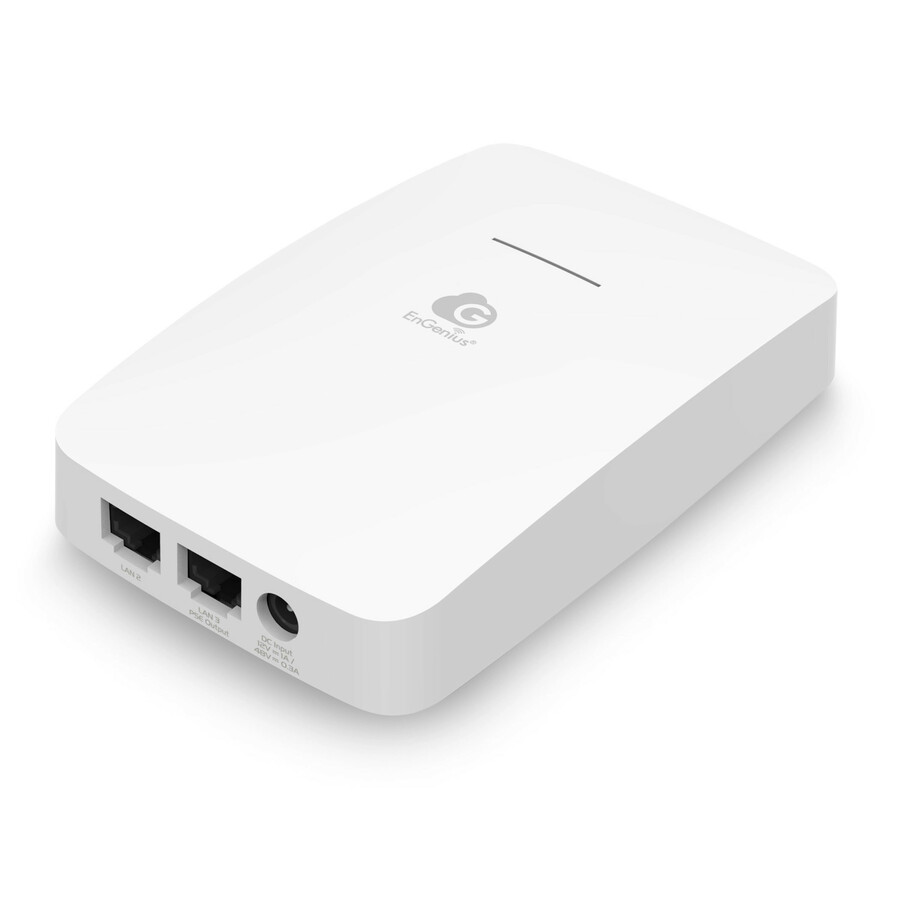
EnGenius Technologies
EnGenius ECW215 Dual Band IEEE 802.11ax 1.73 Gbit/s Wireless Access…
ECW215
A dual-band 802.11ax access point rated 1.73 Gbit/s with PoE and a ceiling mount — the pragmatic fit where the client fleet has no 6 GHz radios yet.
$158.73Back-ordered6E, higher density

Sophos
Sophos AP6 840E Tri Band Wi-Fi 6E IEEE 802.11ax Wireless Access Point
AP84EU00ZZPCNP
A tri-band 6E access point with two 2.5 Gigabit ports and a 45 W draw — the shape that makes the uplink and PoE budget part of the decision.
Plan multi-gig switch ports and PoE++ headroom before ordering access points at this class.
Request pricingFAQ
Common questions
- Is Wi-Fi 6E faster than Wi-Fi 6?
- Not because of new radio technology, they use identical 802.11ax modulation. Wi-Fi 6E can deliver higher real-world throughput because the 6GHz band has more room for wide 160MHz channels and no contention from legacy devices, so speeds hold up better under congestion. On an empty 5GHz channel of the same width, peak rates are effectively the same.
- Do my existing devices work with a Wi-Fi 6E access point?
- Yes. Wi-Fi 6E access points are backward compatible and still serve 2.4GHz and 5GHz, so older clients connect normally. However, only devices with 6E-capable radios can use the 6GHz band. Deploying 6E access points to a fleet with no 6E clients gives you no benefit from the new spectrum until those clients arrive.
- Why does Wi-Fi 6E have shorter range than Wi-Fi 6?
- Higher frequencies attenuate faster and penetrate walls and floors less effectively, so 6GHz signals weaken over distance more quickly than 5GHz. In practice this can mean more access points for equivalent coverage. The 6GHz band is best suited to open, high-density spaces rather than long-range or heavily partitioned layouts.
- Will Wi-Fi 6E require network upgrades beyond the access points?
- Often yes. Because 6E access points can move substantially more traffic, a single gigabit uplink can become the bottleneck, so multi-gigabit switch ports and adequate PoE (PoE+ or PoE++) are common requirements. Budget for backhaul and cabling review, not just the access-point count, when planning a 6E rollout.
- What is the difference between 802.11ax and Wi-Fi 6E?
- They are not alternatives. 802.11ax is the IEEE radio standard; Wi-Fi 6 is the Wi-Fi Alliance's marketing name for certified 802.11ax gear, and Wi-Fi 6E is that same certification extended to the 6 GHz band. So a Wi-Fi 6E access point is an 802.11ax access point with a third radio. If a datasheet says 802.11ax without saying 6E or listing a 6 GHz radio, it is a Wi-Fi 6 device.
- Do I need Wi-Fi 6E, or is Wi-Fi 6 enough?
- Wi-Fi 6 is enough unless three things are true at once: the 5 GHz band in that space is congested, enough of your clients have 6 GHz radios to use the new band, and the switching can feed the access point a multi-gig uplink with PoE+ or PoE++. Where any of those is missing the 6 GHz radio sits idle and you have paid for spectrum nothing is using. The common answer is a mixed fleet: 6E in the dense rooms, Wi-Fi 6 everywhere else.