
Short answer
The 3-2-1 backup rule means keeping three copies of important data — the production copy plus two backups — on two different media types, with one copy stored offsite. The 3-2-1-1-0 extension adds one offline or immutable copy and zero errors on a restore that was actually tested.
Key facts
- The US-CERT paper Data Backup Options states the rule as three copies of any important file: one primary and two backups.
- The two media types exist to protect against different kinds of hazard, and the offsite copy is stored outside the home or business facility.
- CISA's #StopRansomware Guide tells organizations to maintain offline, encrypted backups of critical data and to test restores in a disaster-recovery scenario.
- CISA warns that immutable cloud storage does not meet compliance criteria for certain regulations and that misconfiguration can impose significant cost.
- RAID is not one of the three copies: it survives a drive failing, not deletion, corruption or the loss of the chassis the array sits in.
By Uniqcli Team
The 3-2-1 backup rule says to keep at least three copies of your data, stored on at least two different types of media, with at least one copy kept off-site. The three copies include the production data itself plus two backups, so the rule is asking for two independent recovery options rather than three separate backup jobs. It is a design heuristic rather than a standard, which is precisely why it has outlived every technology it was written about.
The shorthand is generally credited to the photographer Peter Krogh, who set it out in his 2005 book on digital asset management, and it has since been restated by essentially everyone with an interest in data surviving — including CISA, whose Data Backup Options publication puts it in the same three numbers: three copies of an important file, on two different media types, with one stored off-site. Each number is defending against a different category of loss, and reading the rule as three arbitrary requirements rather than three distinct threats is how organizations end up satisfying it on paper while remaining exposed.
What each number is actually for
Three copies is about independent failure. One copy is a single point of loss. Two copies protect against the ordinary case in which one of them fails, but they also share a fate whenever the failure is correlated — the same controller, the same rack, the same script, the same mistake. The third copy exists so that a single event, including the event of a backup itself being silently corrupt, does not take the last remaining version with it. It is worth counting honestly here: a RAID array is not two copies, because RAID protects against a failed drive rather than against deletion, corruption, or ransomware, all of which write to every member at once.
Two media types is about correlated defects. Identical devices bought together fail in similar ways at similar times — the same firmware bug, the same manufacturing batch, the same wear pattern under the same workload. Different media break the correlation. Historically that meant disk and tape; today it just as often means production flash, a disk-based backup appliance, and object storage on a different platform entirely. The test is not whether the two things look different in a diagram but whether a defect in one has any plausible way of affecting the other.
One copy off-site is about the building. Fire, flood, theft, prolonged power loss, and physical destruction do not respect how well organized the rack is. Off-site means a genuinely separate failure domain, far enough away that a single physical event cannot reach both. This is also the number that quietly changed meaning when backup moved to the cloud, which is worth its own passage.
Two media types, when everything is a disk
The usual objection to the rule is that the media distinction is obsolete now that production, backup, and cloud storage are all ultimately flash or spinning disk. That reading is too literal. What the second number defends against is a shared failure mode, and shared failure modes today are less often about the physical medium than about the platform, the vendor, the firmware, the management plane, and the credentials. Two arrays of the same model, administered from the same console with the same account, are one medium for every purpose that matters.
Read that way, the rule remains straightforward to satisfy. A backup appliance from a different vendor than the production array, object storage on a different platform, and tape all count as a second type; a replica of production onto identical hardware managed by the same team with the same credentials does not, whatever the storage layer underneath. Tape retains one property nothing else has, which is that a written cartridge leaves the drive entirely and has no network interface at all — the reason it keeps reappearing in resilience designs long after it was declared finished.
Off-site is not the same as somewhere else
Cloud backup satisfies the off-site requirement geographically, and geography was never the whole point. A copy replicated into the same cloud account, reachable by the same identity provider, administered by the same credentials as production, is in a different building and the same failure domain. The events the third copy exists for now include credential compromise and account-level destruction, and against those, distance contributes nothing.
The useful question is what a copy is independent of. A separate physical site is independent of a fire. A separate cloud account or tenant with separate credentials is independent of an identity compromise. Offline or removable media is independent of anything that requires a network path. Most organizations discover, when they write this out, that their three copies are independent along one axis and identical along another — usually all reachable from one directory service — and that fixing it is a permissions and architecture change rather than a purchase.
What the rule does not cover, and 3-2-1-1-0
Two gaps have opened since 2005, and both were exposed by ransomware. The rule says nothing about whether a copy can be deleted — an attacker with administrative credentials can satisfy all three numbers and then remove all three copies in an afternoon, which is a routine part of how these intrusions are run. And it says nothing about whether a copy works: an unverified backup is a hypothesis, and the discovery that a restore fails, or takes days against an eight-hour objective, tends to happen exactly once, at the worst possible moment.
A widely circulated extension addresses both by adding two more digits: 3-2-1-1-0. The fourth digit calls for one copy to be offline, air-gapped, or immutable — a copy the credentials that administer everything else cannot destroy. The fifth calls for zero errors, meaning recovery verification is performed and passes rather than being assumed. Neither is a new idea, and both are what CISA's ransomware guidance has been saying in plain language for years: maintain offline, encrypted backups, and regularly test their availability and integrity, because ransomware variants actively hunt for and delete any backups they can reach.
The methodology underneath the shorthand
For federal systems, the document that actually governs this territory is NIST SP 800-34 Revision 1, the Contingency Planning Guide for Federal Information Systems. It does not use the phrase 3-2-1 and should not be cited as if it did. What it requires is the substance the shorthand is a mnemonic for: a business impact analysis that establishes which systems matter and in what order, recovery time and recovery point objectives derived from that analysis rather than chosen by preference, a documented backup strategy proportionate to the system's impact level, alternate storage and processing site selection with explicit criteria including distance from the primary site, and testing and exercises to prove the plan works.
That is the more useful frame for anyone writing a requirement. 3-2-1 tells you the shape of a defensible design in six words, which is why it survives; SP 800-34 tells you how to justify the specific numbers for your environment, which is what an auditor asks for. Recovery objectives are the hinge between them. An RPO of fifteen minutes and an RPO of twenty-four hours produce entirely different architectures at identical copy counts, and the copy count is the cheap part of the decision.
Turning the rule into a bill of materials
Once the copies are decided, the hardware follows fairly directly. Copy one is production. Copy two is normally an on-premises backup target sized for the retention window and the change rate — a NAS or a purpose-built backup appliance, on different hardware from the production array and, where possible, under different credentials. Copy three leaves the site, as object storage on a separate platform, as tape written and rotated offsite, or both. Where 3-2-1-1-0 is being followed, the offline or immutable copy is usually a retention lock on the object tier or the tape leg rather than a fourth device.
Two costs get missed in this exercise with some regularity. Capacity is not the copy multiplied by three, because deduplication, compression, and different retention windows apply to each tier differently, and locked retention on an immutable tier cannot be relieved by deleting things when the repository fills. And restore testing needs somewhere to restore to — spare capacity, or a target environment that exists for the purpose — which is a line item that gets cut precisely because it is not the backup itself. The practical move at quote time is to send the design rather than the drive count: three copies, their media, their retention, and the recovery objectives they exist to meet. That is what turns a capacity number into a bill of materials that survives contact with the restore.
Key takeaways
- Three copies, two media types, one off-site — the three copies include production, so the rule is asking for two independent recovery options rather than three backup jobs.
- The shorthand is credited to photographer Peter Krogh's 2005 book on digital asset management, and CISA's Data Backup Options publication restates it in the same three numbers.
- RAID is not a second copy: it protects against a failed drive, not against deletion, corruption, or ransomware, all of which write to every member of the array at once.
- "Two media types" now means two independent failure modes — different platform, vendor, management plane, and credentials — not literally two physical technologies.
- Cloud satisfies off-site geographically, but a copy reachable from the same account and identity provider as production is in the same failure domain against credential compromise.
- 3-2-1-1-0 extends the rule with one offline, air-gapped, or immutable copy and zero errors from verified recovery testing — the two gaps ransomware exposed.
Shop it at Uniqcli
Parts for this job
Onsite copy

QNAP Systems
QNAP Turbo NAS TS-464-8G SAN/NAS Storage System
TS-464-8G-US
A four-bay desktop NAS with a quad-core Celeron, 8 GB of memory and 2.5 Gigabit Ethernet, supporting RAID 0, 1, 5, 6 and 10 — the second copy, on different media.
$741.72Back-orderedSecond site
Ubiquiti
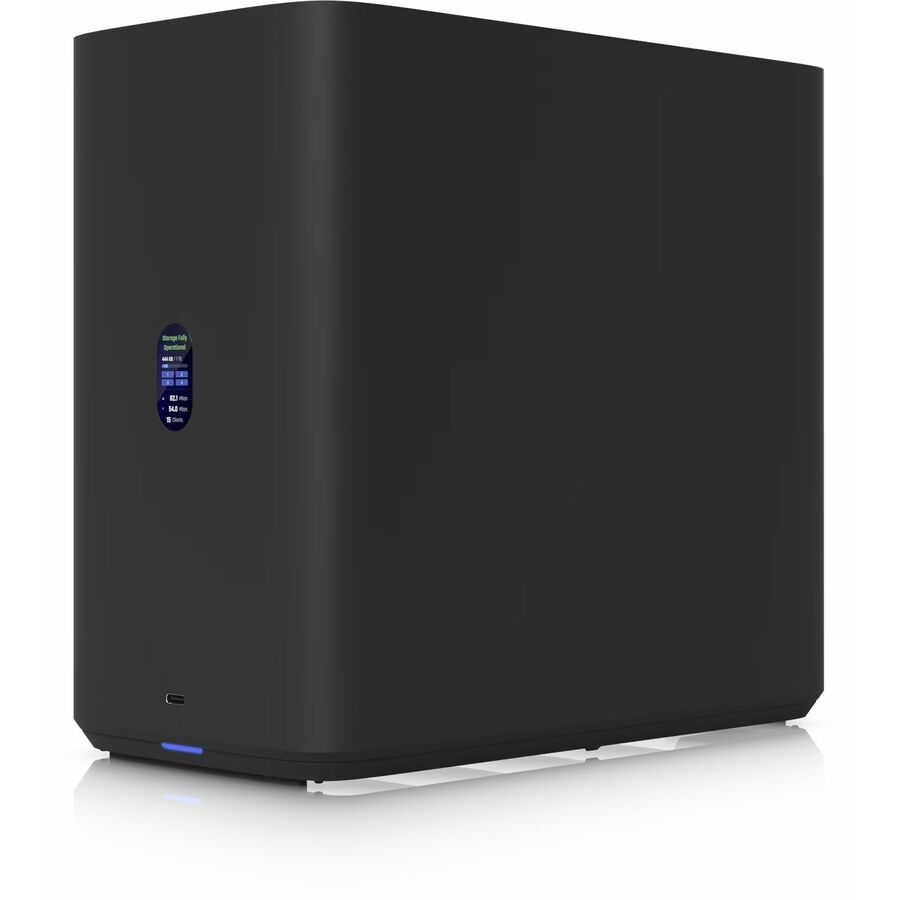
Ubiquiti UNAS-4-B NAS Storage System
UNAS-4-B
A four-bay desktop NAS with 2.5 Gigabit Ethernet and RAID 5, 6 and 10, small enough to sit at a branch or a second building as the offsite copy.
Offsite means a different building, not a different shelf. A second unit in the same room fails with the room.
$491.53Back-orderedFrequently asked
- Does the 3-2-1 rule count the production data as one of the three copies?
- Yes. The three copies are the live production data plus two backups, which means the rule is asking for two independent recovery options rather than three separate backup sets. Counting it the other way is not wrong so much as more expensive than the rule requires, and it tends to produce a third copy that is a near-duplicate of the second rather than genuinely independent of it. The more useful discipline is to ask what each copy is independent of — a failed device, a corrupted job, a lost building, a compromised credential — because two copies independent along different axes protect more than three copies that share a fate.
- Does RAID count as one of the copies?
- No. RAID protects against a drive failing, and it does that well, but every other threat writes to all members of the array simultaneously. Accidental deletion deletes from all of them. File corruption corrupts all of them. Ransomware encrypts all of them. A controller failure, a filesystem fault, a fire, or a theft takes the whole array at once. RAID is uptime insurance for the storage layer and belongs in a design for that reason, but it produces one copy of the data, not two, and treating it as a backup is one of the more common and more costly mistakes in small and mid-size estates.
- Is the 3-2-1 rule obsolete now that backups go to the cloud?
- The numbers are not obsolete; the literal reading of the second one is. "Two media types" was written when the meaningful distinction was disk versus tape, and what it was actually defending against was a correlated failure — the same firmware, the same batch, the same wear pattern. Today the correlated failures are as likely to be platform, vendor, management plane, and credential based, so two arrays of the same model administered from one console with one account are effectively one medium. Cloud also satisfies "off-site" geographically while leaving the copy in the same failure domain if it shares an identity provider with production. Read for independence rather than for hardware, the rule holds up well.
- What is the 3-2-1-1-0 rule?
- It is an extension of the original that adds the two things ransomware exposed. The fourth digit calls for one of the copies to be offline, air-gapped, or immutable — a copy the credentials that administer the rest of the environment cannot delete, which is the specific scenario the original rule never contemplated. The fifth calls for zero errors, meaning recovery is actually verified rather than presumed, with restores tested and timed against the recovery objective. Neither addition introduces a new idea; both restate what CISA's ransomware guidance says in plain language, which is to keep offline encrypted backups and to test their availability and integrity regularly.
- Does NIST require the 3-2-1 rule?
- No, and it is worth being precise because the claim circulates widely. NIST SP 800-34 Revision 1, the Contingency Planning Guide for Federal Information Systems, does not use the 3-2-1 shorthand anywhere. What it requires is the underlying substance: a business impact analysis to establish which systems matter, recovery time and recovery point objectives derived from that analysis, a backup strategy proportionate to the system's impact level, alternate storage site selection against explicit criteria including distance from the primary site, and testing to prove the plan works. 3-2-1 is a convenient summary of what a compliant design tends to look like, not a citation you can put in a control response.
- How often should backups be tested?
- Often enough that the first full restore is not happening during an incident, which for most organizations means at least annually for a full recovery exercise and considerably more frequently for individual file and system restores. Test the things that actually break: whether every application in scope is present, whether the encryption keys exist somewhere outside the environment being recovered, whether dependencies come back in a workable order, and how long the whole sequence takes end to end. That last number is the one to record, because a restore that completes in four days against an eight-hour recovery objective is a failed test even though every file came back.
- Where did the 3-2-1 backup rule come from?
- It entered federal guidance through Data Backup Options, a paper written by Paul Ruggiero and Matthew Heckathorn of Carnegie Mellon University for US-CERT, which states it as keeping three copies of any important file — one primary and two backups — on two different media types, with one copy stored offsite. The paper credits the formulation to Peter Krogh's The DAM Book, second edition, page 207, where it was framed for photographers protecting image archives. The numbers have travelled unchanged since; what has changed is what counts as a medium.
Sources
Keep reading