
Short answer
The main difference between a DAC and an optical transceiver is where the signal stays electrical. A DAC is a fixed-length twinax assembly with the connectors fused on, good for a few metres inside a rack; an optical transceiver turns the signal into light and drives fiber for hundreds of metres. Both plug into the same SFP or QSFP cage, so the decision is span length, cost and power.
Key facts
- SFF-8431 is the SFP+ electrical specification that covers both optical modules and twinax direct attach copper links.
- Passive SFF-8431 twinax assemblies are typically up to 5 m; active cables condition the signal in the connector and reach further.
- A DAC carries no laser — only an identification EEPROM — so its per-port power is negligible next to an optical module's watt or more.
- Cisco's 10GBASE-SR datasheet gives 300 m on OM3 multimode fiber — two orders of magnitude past a passive DAC.
- 25 Gigabit Ethernet, including its twinax variant, is IEEE Std 802.3by-2016; the 100 Gb/s fiber work is IEEE Std 802.3bm-2015.
At the physical layer, connecting a server to its top-of-rack switch, or one switch to another, comes down to a recurring choice: a direct attach copper (DAC) cable with the connectors permanently fused to a twinaxial cable, or a pair of pluggable optical transceivers joined by a fiber patch cord. Both terminate in the same SFP/QSFP cages and negotiate the same link speeds, so from the switch's perspective they are largely interchangeable. The difference is in reach, cost, power, and how the cable behaves in the rack.
The decision is almost always driven by distance. DAC is a fixed-length assembly engineered for very short runs, so it excels inside a rack or between adjacent racks; beyond a few meters its signal integrity runs out and optical takes over. Because DAC carries no lasers it is dramatically cheaper per link and draws almost no power, which matters at scale. Optical costs more and draws more power per port -- around a watt at low speeds, several watts for high-speed modules -- but buys you reach, thin flexible cabling, field-swappable modules, and immunity to electrical noise. Neither wins universally: the right answer depends on the span you are cabling and how many of those spans you are buying.
At a glance
Side by side
| Factor | DAC (direct attach copper) | Optical transceiver + fiber |
|---|---|---|
| Practical reach | Short: passive ~1-3m at 100/400G, up to ~5-7m at 10/25G; active DAC extends the upper end | Long: multimode ~100m class over OM4; single-mode reaches kilometers with the right optics |
| Cost per link | Low; a single fused assembly with no separate optics | Higher; two transceiver modules plus a fiber patch cord |
| Power per port | Negligible for passive (just an ID EEPROM); active DAC draws a modest amount for its signal conditioning | Roughly a watt at low speeds up to several watts for high-speed modules (a laser, plus DSP in PAM4 optics); adds up across thousands of ports |
| Cabling & airflow | Thick, stiff twinax with a larger bend radius; bulky in dense bundles | Thin, light, flexible fiber; easier routing, tighter bends, better airflow |
| Flexibility | Fixed length and speed; the whole assembly is replaced if either end fails | Modules and fiber are separate and field-swappable; lengths reworked via patch panels |
| Latency | Marginally lower with passive DAC (no electrical-optical conversion or DSP retiming); difference is negligible in practice | Adds electrical-to-optical conversion, plus DSP retiming on PAM4 optics; effectively wire-speed for nearly all workloads |
| Signal integrity | Copper; susceptible to EMI and crosstalk in dense, noisy environments | Fiber is immune to EMI and provides galvanic isolation between endpoints |
| Typical role | Intra-rack server-to-ToR and switch-to-switch stacking links | Cross-row, leaf-spine uplinks, and any run beyond a few meters |
Choose DAC (direct attach copper) when
- The link stays inside one rack or reaches an adjacent rack, within a few meters
- You are cabling many identical short runs and want the lowest cost and power per port
- Server-to-top-of-rack or switch stacking links dominate the design
- Rack power and cooling budgets are tight and every watt per port counts at scale
Choose Optical transceiver + fiber when
- The run crosses rows, zones, or floors, or otherwise exceeds DAC's short reach
- You need thin, flexible cabling for high port density and clean airflow
- Field-swappable optics and reworkable fiber lengths matter for lifecycle flexibility
- The path runs through electrically noisy areas where EMI immunity and isolation help
Bottom line
Treat this as a distance-first decision, not a quality contest. For the dense, short, repetitive links inside a rack, DAC is usually the pragmatic default: cheaper, near-zero power, and simple. The moment a span outgrows a few meters, crosses a row, or benefits from thin fiber and swappable optics, the reach and manageability of optical justify its higher cost and power. Most well-designed data centers use both deliberately: DAC for server-to-ToR and in-rack switch links, optical for uplinks and anything that leaves the rack.
Products for this decision
In-rack copper
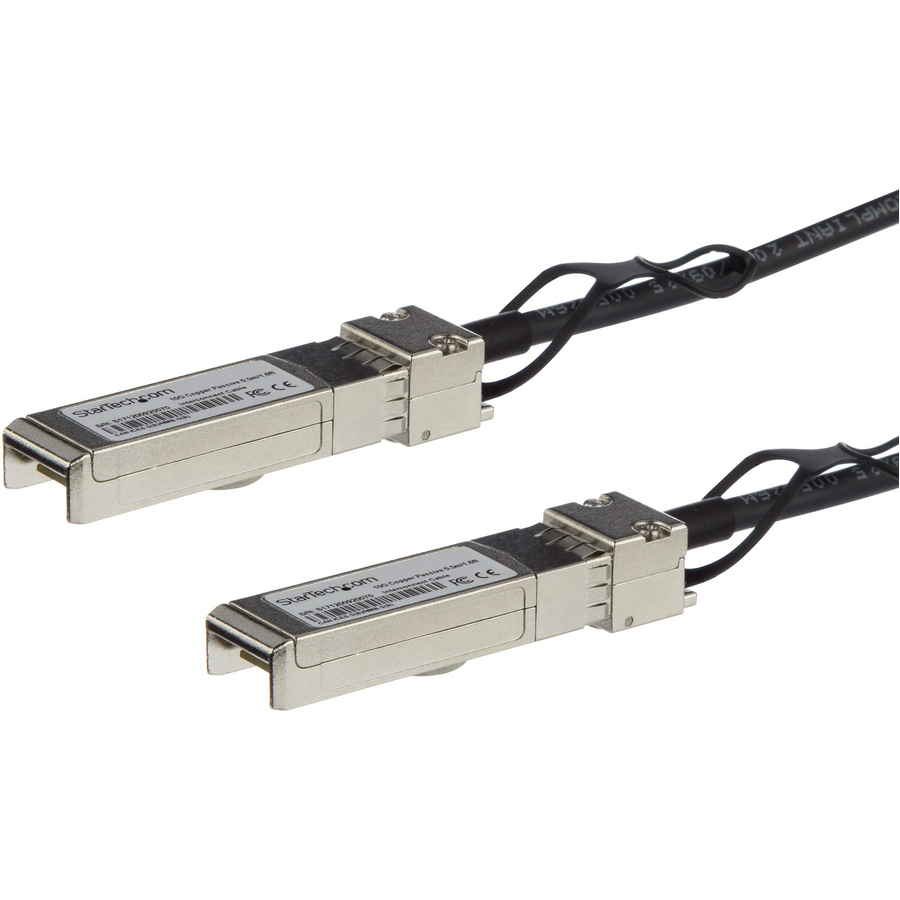
StarTech.com
StarTech 3m SFP+ to SFP+ Direct Attach Cable for Juniper…
EXSFP10GEDA3
A 3 m passive SFP+ twinax assembly for 10GbE — server to top-of-rack, or switch to switch inside one cabinet.
DAC is a fixed length: measure the run before ordering, because the assembly cannot be re-terminated.
$16.55In stock40G copper
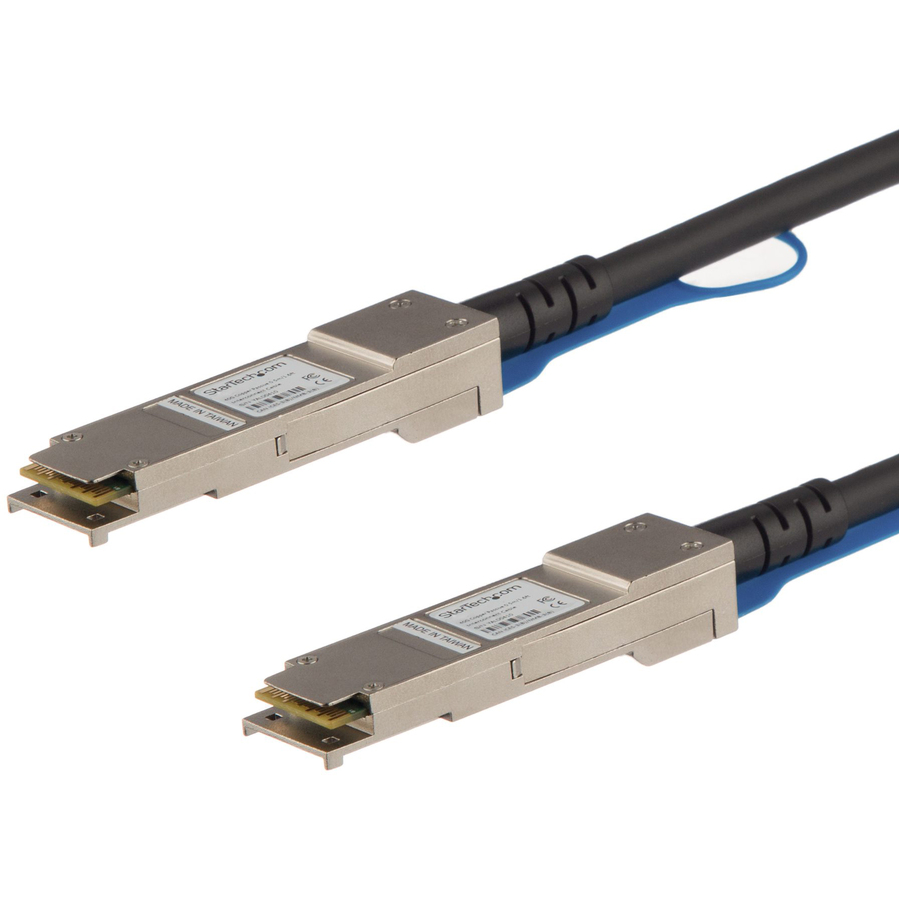
StarTech.com
StarTech 3m 40G QSFP+ to QSFP+ Direct Attach Cable for Cisco…
QSFPH40GCU3M
The QSFP+ version of the same idea, carrying 40GbE over passive twinax for short uplinks between adjacent racks.
$34.95In stockThe optical side
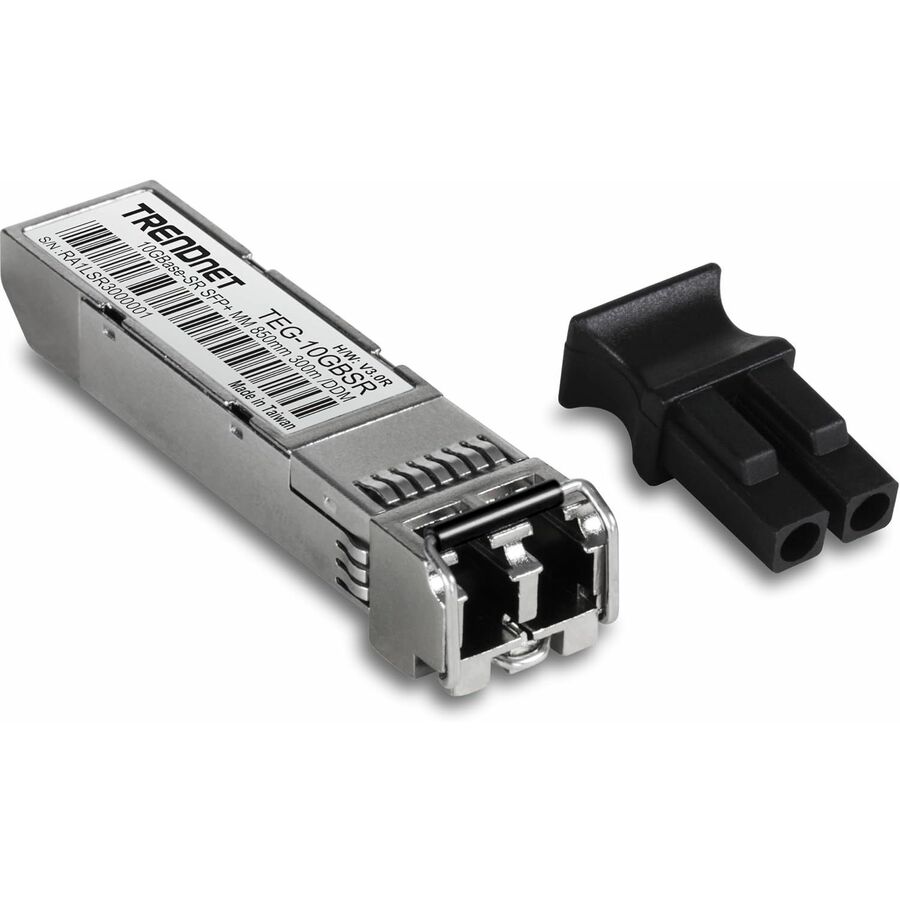
TRENDnet
TRENDnet 10GBASE-SR SFP+ Multi Mode LC Module, TEG-10GBSR, Supports…
TEG-10GBSR
A 10GBASE-SR SFP+ module on 850 nm optics reaching about 300 m over multimode fiber — one is needed at each end, plus a duplex LC patch cord.
$44.57*Back-orderedShop it at Uniqcli
FAQ
Common questions
- How far can a DAC cable actually run?
- It depends on speed and whether the cable is passive or active. Passive DAC is typically limited to about 1-3 meters at 100G/400G and up to roughly 5-7 meters at 10G/25G. Active DAC, which conditions the signal with electronics in the connectors, extends the upper end (on the order of 10 meters at 25G, more at 10G). For a fixed cable beyond that, active optical cables bridge the gap, and past a handful of meters pluggable optics on fiber become the appropriate choice.
- Is DAC meaningfully lower latency than optical?
- Passive DAC avoids the electrical-to-optical conversion and, on PAM4 links, the DSP retiming inside an optical module, so it carries a small latency edge measured in nanoseconds to tens of nanoseconds. For the overwhelming majority of workloads that difference is negligible, and both link types are effectively wire-speed. Distance, cost, and power are far more decisive selection factors than latency.
- Why does power consumption differ so much between the two?
- Optical transceivers contain a laser and, at high speeds, digital signal processing, so a module draws on the order of a watt at low speeds up to several watts for high-speed optics. Passive DAC has no active optics; it only carries an EEPROM for identification and draws negligible power. Across thousands of ports, that per-port difference adds up to a real power and cooling consideration in large fabrics.
- Can DAC and optical be mixed in the same switch and fabric?
- Yes. Both plug into the same SFP/QSFP cages and negotiate the same speeds, so a single switch commonly runs DAC on short in-rack links and optical on longer uplinks. Mixing them by span length is standard practice and lets you optimize cost and power without compromising the runs that need optical reach.
- What is a twinax cable?
- Twinax, short for twinaxial, is the two-conductor shielded copper cable inside a direct attach assembly — a pair of signal wires sharing one shield, which is what lets it carry multi-gigabit serial lanes over a short distance. When a listing says twinax, DAC or 10GBase-CU, it is describing the same thing: an SFP or QSFP assembly with the connectors permanently fitted.
- What is the difference between passive and active DAC?
- A passive DAC is just shielded twinax with an identification EEPROM in each connector, so the host's own equalisation has to cope with the whole cable — which is why SFF-8431 puts typical passive lengths at a few metres. An active DAC adds signal-conditioning electronics inside the connectors to extend that reach, at the cost of a small amount of power per port and a higher price.
- Are DAC cables interchangeable between switch vendors?
- Physically yes, operationally not always. The connectors and electrical interface follow the SFP+ or QSFP+ specification, but many switches read the EEPROM and will warn about, or refuse, an assembly they do not recognise. Cables are sold coded for a particular platform for exactly this reason, so match the coding to the switch you are cabling.