
Short answer
C13 and C19 differ in size and current: a C13 connector mates only with a C14 inlet and a C19 only with a C20, and the C19/C20 pair is the higher-current one used by large power supplies and rack UPS units. They are not interchangeable — the bodies are different sizes and will not mate — so the equipment's inlet decides which cord and which PDU outlet you need.
Key facts
- IEC 60320-1 is the standard that defines these appliance couplers; the 2021 fourth edition replaced the 2015 edition and its 2018 amendment.
- The connectors mate in fixed pairs: a C13 goes onto a C14 inlet and a C19 onto a C20 inlet. A C13 and a C19 never mate with each other.
- C19/C20 is the higher-current pair, which is why it appears on large server power supplies, blade chassis and rack UPS units rather than on ordinary hosts.
- Cords sold in North America carry the rating of their own national listing — a heavy-duty C19 to C20 cord is commonly UL Listed at 20 A, 250 V on 12 AWG.
- The connector type says nothing about voltage: C13 and C19 are both used at 120 V and at 208-240 V, and the circuit feeding the PDU decides.
- An adapter does not change a rating — the lowest-rated element in the path governs the whole path.
Nobody looks this up until a rack build is half finished and a power supply will not mate with the PDU in front of it. C13 and C19 are both IEC 60320 outlets — the same family, the same standard, different current ratings — and picking the wrong mix means either a PDU full of outlets nothing plugs into, or a device that arrives with a cord end the rack cannot accept. The distinction is worth ten minutes before the order and an afternoon after it.
The short version: C13 is the smaller outlet rated at 10 A, and it is what the overwhelming majority of servers, switches, routers and appliances present. C19 is the larger outlet rated at 16 A, and it is what high-draw equipment uses — big multi-socket server power supplies, blade chassis, larger UPS units and some storage shelves. The mating inlets on the equipment are C14 and C20 respectively, which is why the cord you actually order is usually described as C13-to-C14 or C19-to-C20.
Getting the pairing right is only half the job. The other half is the PDU's own supply: total capacity, input plug type and voltage all constrain how many of each outlet you can actually load, and a PDU with plenty of free C13 sockets can still be at its limit. Count the load before counting the outlets.
At a glance
Side by side
| Factor | C13 outlet | C19 outlet |
|---|---|---|
| Current rating | 10 A | 16 A |
| Mating inlet on the equipment | C14 | C20 |
| Physical size | Smaller, three rectangular contacts | Noticeably larger; will not fit a C14 inlet |
| Typical equipment | Servers, switches, routers, firewalls, most 1U and 2U appliances | High-draw server power supplies, blade chassis, larger UPS units, some storage shelves |
| Typical share of a rack PDU | The majority of outlets on most rack PDUs | A smaller number of outlets, often grouped at one end |
| Cord you order | C13-to-C14 jumper within the rack; C13 to a wall plug outside it | C19-to-C20 jumper within the rack; C19 to a higher-rated plug outside it |
| Adapters | C13-to-C19 and C19-to-C13 adapters exist | Adapting up does not raise a device's rating — the lower-rated element still governs |
| Where it bites | Ordering a PDU that is all C13 when two devices need C19 | Ordering C19-heavy when almost nothing in the rack uses it |
Specify C13 outlets when
- The rack is servers, switches, routers, firewalls and 1U or 2U appliances — the normal case
- You are buying jumper cords to go from a rack PDU to equipment inlets marked C14
- You want the highest usable outlet count in a given PDU footprint
- You are standardising cords across a fleet and want one part number to cover most of it
Specify C19 outlets when
- The rack holds high-draw equipment — large multi-socket server power supplies, blade chassis or a rack UPS
- A device arrived with a C20 inlet, which no C13 cord can serve
- You are feeding a downstream PDU or a device whose nameplate exceeds what a 10 A path should carry
- The build is being specified now and you would rather have two spare C19 outlets than none
Bottom line
Count the equipment before you choose the PDU. Most racks are overwhelmingly C13 and a small number of C19 outlets covers the exceptions — but the exceptions are the expensive ones to get wrong, because a device with a C20 inlet simply cannot be plugged into a C13 outlet. Look at every device's inlet, not its price or its size, then pick a PDU whose outlet mix matches with a little headroom on the C19 side. And confirm the PDU's total capacity, input plug and voltage separately: free sockets are not the same as free amps, and a PDU can run out of capacity long before it runs out of outlets.
Products for this decision
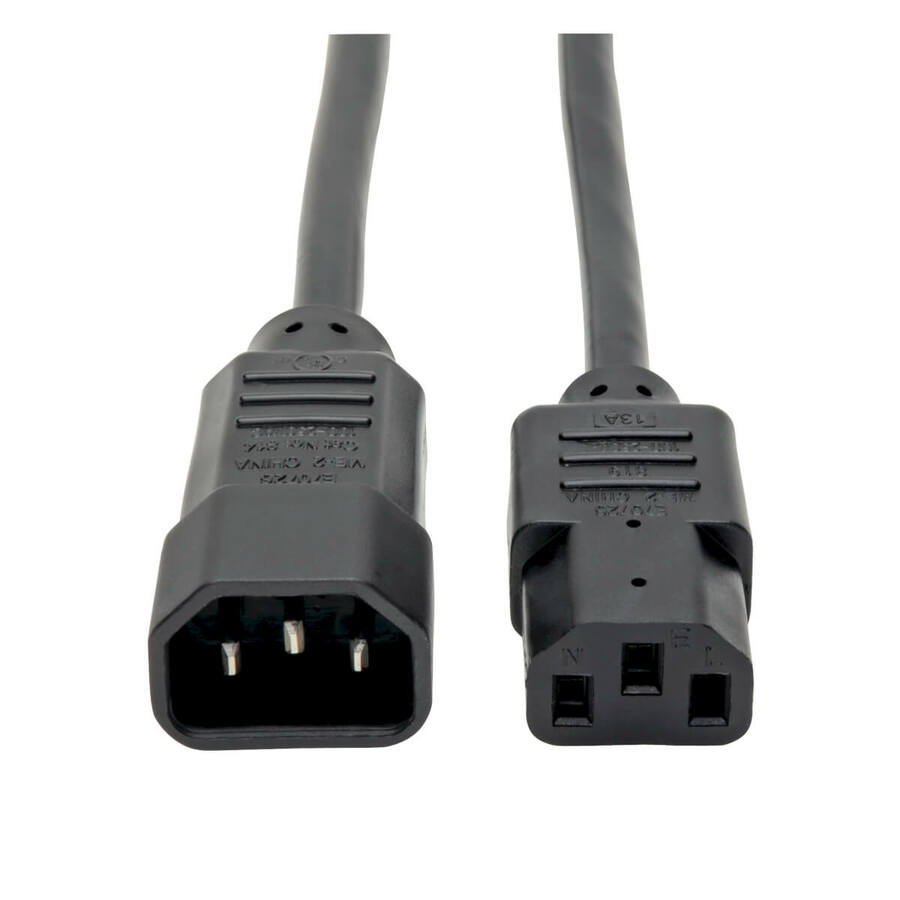
C13 to C14 jumper
Eaton
Eaton Tripp Lite Series PDU Power Cord, C13 to C14
P004-002
A 2 ft 10 A jumper for the ordinary case — a server, switch or appliance with a C14 inlet fed from a C13 outlet on the rack PDU.
Buy the length you need. Short jumpers keep a rack's airflow and cable management honest; coiled slack does neither.
$8.62Back-orderedC19 to C20, 20 A
StarTech.com
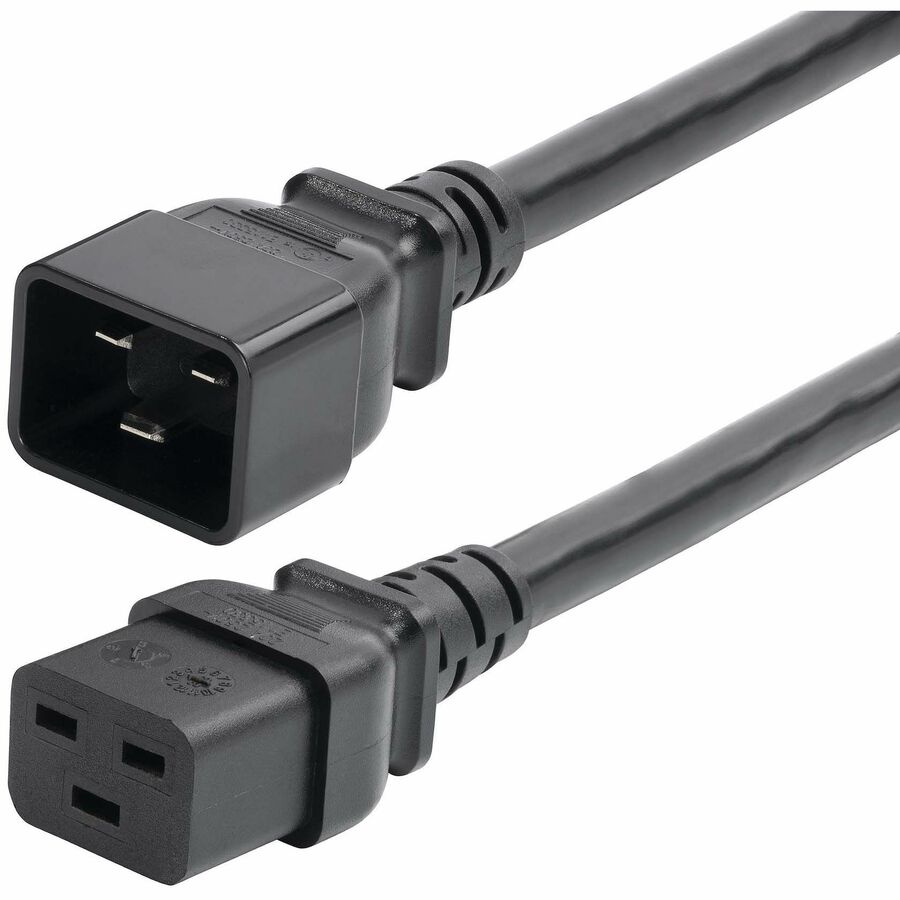
StarTech 2ft (60cm) Heavy Duty Extension Cord, IEC 60320 C19 to C20…
BA16-2200-POWER-CORD
A 2 ft 12 AWG extension in the larger pair, rated 20 A at 250 V, for the devices whose inlet is a C20 rather than a C14.
$16.96*In stockC19 to C20, colour-coded
Legrand
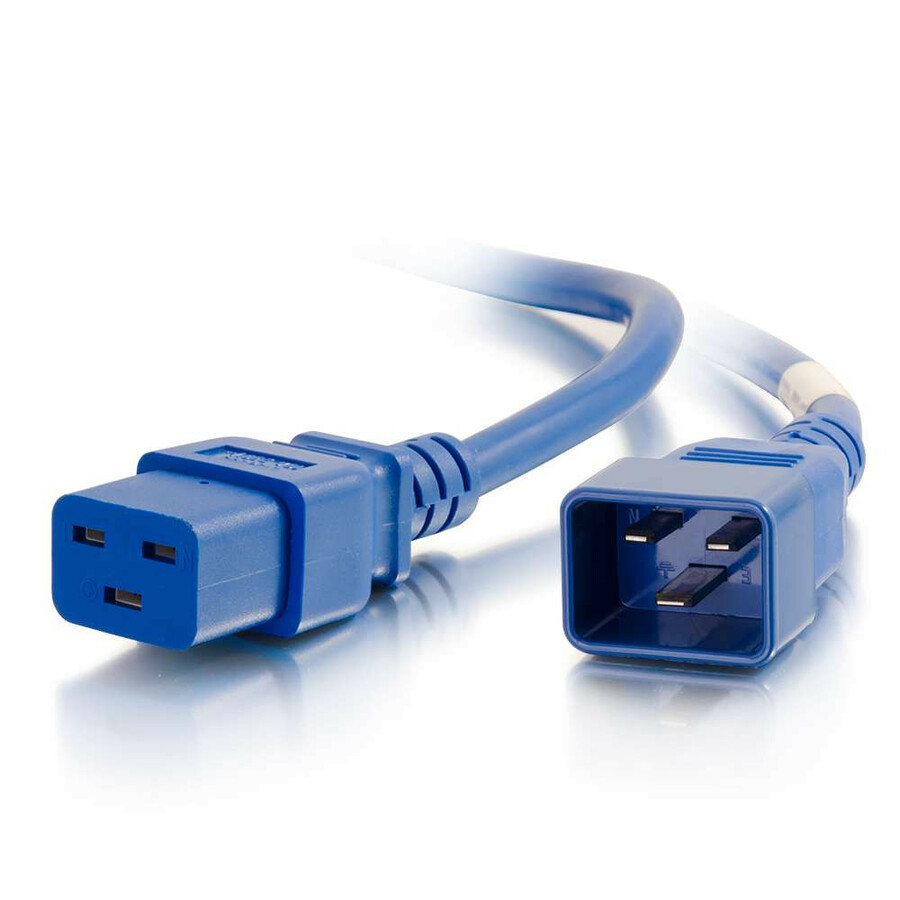
C2G Standard Power Cord - 1 ft
17708
A 1 ft C19 to C20 cord rated 20 A at 250 V, in a colour, for racks that mark the A and B feed by cord colour rather than by label.
$25.02*In stockShop it at Uniqcli
FAQ
Common questions
- What is the difference between C13 and C14?
- They are the two halves of one connection, not two alternatives. C13 is the outlet — the socket end, found on a rack PDU or on the cord that plugs into equipment. C14 is the inlet — the pin end, found on the back of a server, switch or appliance. So a jumper cord inside a rack is described as C13-to-C14: the C13 end goes onto the equipment's C14 inlet, and the other end of the cord plugs into the PDU. C19 and C20 are the same relationship one size and rating up.
- Can I plug a C13 cord into a C19 outlet?
- Not directly — they are physically different sizes and will not mate. Adapters exist in both directions, and they have their place in a temporary or a retrofit situation, but adapting does not change any device's rating. Whichever element in the chain has the lowest rating governs the whole path, so a C13 cord fed through an adapter from a C19 outlet is still a 10 A path. Where a permanent installation needs a different outlet, the right fix is the correct cord or the correct PDU, not a stack of adapters.
- How many C19 outlets does a rack actually need?
- Usually only a few, but it depends entirely on the equipment. Count the devices with C20 inlets — typically the larger server power supplies, blade chassis, rack UPS units and some storage shelves — and specify at least that many C19 outlets with a little headroom for what gets added later. Everything else in a normal rack is C13. The common mistake is either direction: an all-C13 PDU that cannot serve the two big devices, or a C19-heavy PDU whose outlets sit empty.
- Does the outlet type tell me the voltage?
- No. C13 and C19 describe the connector and its current rating, not the supply voltage, and both are used at 120 V and at 208-240 V. Voltage is a property of the PDU's input and the circuit feeding it, which is why a rack build has to settle the input plug, the circuit rating and the voltage separately from the outlet mix. A PDU with the right outlets on the wrong circuit is still the wrong PDU, so confirm all three together.
- Why does my PDU have free outlets but no capacity left?
- Because outlets and amps are different budgets. A PDU's total capacity is set by its input circuit and its own rating, and it is entirely normal to exhaust the amps while sockets remain. Rack PDUs also often divide their outlets across internal breakers or banks, so one bank can trip while the PDU as a whole is under its limit. Size the PDU against the summed nameplate draw of what it will feed — with headroom — and treat the outlet count as a secondary constraint rather than the primary one.
- Are C19 and C20 the same?
- No — they are the two halves of one connection. C19 is the connector on the end of the cord, the part with the sockets; C20 is the inlet built into the equipment, the part with the pins. A C19-to-C20 cord therefore has one of each: the C19 end goes onto the device's C20 inlet, and the C20 end plugs into the PDU outlet. C13 and C14 have exactly the same relationship one size down.
- What is a C19 plug used for?
- For equipment that draws more current than the smaller pair is rated to carry — typically larger server power supplies, blade and storage chassis, rack UPS units, and the input of some high-capacity PDUs. In an ordinary rack most devices are C14 and only a handful are C20, which is why PDUs mix a few C19 outlets among many C13 ones. If a device has a C20 inlet, that is the manufacturer telling you which cord it needs.
- Is C19 male or female?
- A C19 is the female half — the connector with the recessed contacts that goes onto equipment. The pinned male half it mates with is the C20 inlet. The terminology confuses people because a cord assembly has one of each and is usually named by both ends, so a "C19 cord" has a C19 at the equipment end and something else, usually a C20 or a plug, at the supply end. In IEC 60320's own terms the female half is the connector and the male half is the inlet.
- Are C13 power cords interchangeable?
- Mechanically, largely yes — any C13 connector fits any C14 inlet, which is why a spare cord from another device usually works. Electrically, check three things before treating them as equivalent: the current rating, the conductor gauge, and the length. A thin, long, low-rated cord on a power supply that draws near its limit is the case where an interchangeable-looking cord is not, and the lowest-rated element in the path is what governs it.