
Short answer
A punch-down block terminates solid copper pairs without stripping or screws: a punch-down tool forces each conductor into an insulation-displacement contact, whose edges cut through the insulation to reach the copper and, on an impact tool, trim the excess in the same stroke. The 110 style is used for Category-rated data cabling; 66 blocks belong to older telephone wiring.
Key facts
- IEC 60352-4 covers non-accessible insulation displacement connections for solid conductors 0.25 mm to 3.6 mm in diameter.
- Panduit's 110 system terminates most 22 to 26 AWG solid or stranded wire up to 0.050 in (1.27 mm) outside diameter, PVC or plenum.
- The PDT110 single-wire tool and the PDT110M multi-pair tool both seat and cut the conductors to length in one action.
- 110 connecting blocks come in 3, 4 and 5-pair widths and fill a 100-pair base; the wire strips are color-coded white, red, blue, yellow, violet.
- Panduit rates its 110 system above ANSI/TIA 568.2-D Category 5e and to IEC 60352-4, withstanding up to 200 repeated terminations.
- Cable pairs must remain twisted up to the point of connection for a Category 5e installation.
By Uniqcli Team
A punch-down block is a field-terminated connecting block that joins solid copper pairs without stripping the wire and without screws. Each conductor is pressed into a slotted metal contact whose edges cut through the insulation and bite the copper — an insulation-displacement contact, or IDC. The tool that presses it home is a punch-down tool, and on an impact tool the same stroke also trims the excess conductor.
Two styles dominate. The 110 style is the one used for Category-rated structured cabling: it is what sits behind a patch panel, inside a keystone jack and on a wall-mounted cross-connect field. The 66 style is older telephony hardware, still found in existing closets and still sold, but not the choice for a new data installation.
Blocks look like the simplest part of a cabling job and are the part most often blamed for the results. A block rated to a category is only rated when it is terminated the way the manufacturer specifies — right gauge, right tool, pairs untwisted no further than the contact.
How insulation-displacement termination works
An IDC is a metal slot narrower than the conductor it accepts. Forcing the wire down into it slices the insulation aside and produces a gas-tight metal-to-metal joint under continuous spring pressure — no strip, no screw, no solder. IEC 60352-4 is the international standard for non-accessible insulation displacement connections, covering solid round conductors from 0.25 mm to 3.6 mm in diameter, and it exists precisely so the connection's performance can be compared across different tool and contact designs.
The tool matters as much as the block. Panduit's 110 system is terminated with a PDT110 single-wire punchdown tool or a PDT110M multi-pair tool, and the step in its own instructions is to seat and cut the pairs to length — one action, one stroke, no separate trim. Keeping the tool perpendicular to the base is called out in those instructions as what produces a good termination, which is the usual difference between a field that tests clean and one that does not.
110 blocks: the structured-cabling standard
A 110 field is built in layers. A base — commonly 100 pairs — is mounted to plywood or into a rack panel, incoming cable is dressed into its channels, and the conductors are laid into color-coded wire strips in pair order. Connecting blocks are then punched down over the top, and those come in 3, 4 and 5-pair widths so a 100-pair base can be filled in whatever combination the cable count needs.
Panduit specifies its 110 system for most 22 to 26 AWG solid or stranded wire up to 0.050 in (1.27 mm) outside diameter, in PVC or plenum jackets, and states that the system exceeds all channel and component requirements of ANSI/TIA 568.2-D Category 5e and meets IEC 60352-4, withstanding up to 200 repeated terminations. That last figure is the one to know before re-punching a field repeatedly during troubleshooting.
Its instructions also carry the rule that ruins more Category installations than any other: cable pairs must remain twisted up to the point of connection. Untwisting an extra half inch to make the wire easier to seat is what turns a compliant component into a failed channel test.
66 blocks and where they still belong
The 66 block predates structured cabling and was built for analog telephone distribution: rows of clips, usually in 25-pair columns, bridged in pairs or quads. It uses the same insulation-displacement principle and its own blade profile, which is why impact punch-down tools are sold with interchangeable 110 and 66 blades rather than as two separate tools.
For voice tie-fields, paging systems and legacy PBX cross-connects that already exist, a 66 block is the part that matches what is on the wall. For anything carrying Ethernet, the 110 style is the one with current Category ratings behind it, and mixing the two in the same field is a documentation problem waiting to happen.
What to check before you specify
Match four things: the conductor gauge and jacket the block accepts, the category the block is rated to, the mounting the site needs, and the tool the manufacturer specifies. A 100-pair base with legs stands off a wall or plywood backboard; a rack-mount version consumes rack units, so count them into the cabinet plan alongside patch panels and cable management.
Then buy the tool once. An impact tool with interchangeable blades covers both block styles and, on the 110 side, seats and cuts in one action; a multi-pair tool seats a whole connecting block at a time, which is what makes a 100-pair field a morning's work rather than a day's. Blades are consumable — a dull blade leaves conductors proud of the contact, and that is a fault that tests intermittently.
Key takeaways
- A punch-down block terminates solid copper in insulation-displacement contacts — no stripping, no screws, no solder.
- The 110 style carries current Category ratings and belongs behind patch panels and keystone jacks; the 66 style is legacy telephony hardware.
- IEC 60352-4 covers non-accessible insulation displacement connections for solid conductors from 0.25 mm to 3.6 mm in diameter.
- Panduit's 110 system takes most 22 to 26 AWG solid or stranded wire up to 0.050 in (1.27 mm) outside diameter, PVC or plenum.
- It is rated above ANSI/TIA 568.2-D Category 5e and to IEC 60352-4, withstanding up to 200 repeated terminations.
- Pairs must stay twisted to the point of connection, and an impact tool seats and cuts the conductor in one stroke.
Shop it at Uniqcli
Parts for this job
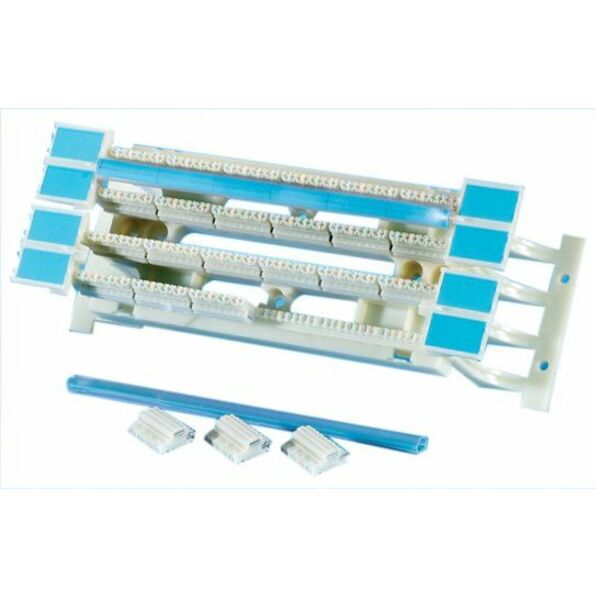
Category 6 cross-connect field
Legrand
Ortronics 110 BLOCK,CAT6 100PR
110ABC6100
Ortronics 110 block rated to Category 6 and Category 5e, 100 pairs in white — the wall or rack field a structured-cabling cross-connect is built on.
$179.31Back-ordered100-pair base with legs
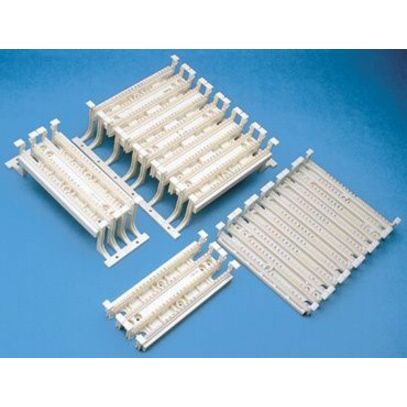
Legrand
Ortronics 110 Block,100PR W/Legs
30200145
Ortronics 110 block, 100 pairs, supplied with legs so the base stands off a plywood backboard and cable can be dressed behind it.
$41.10Back-orderedThe tool
Legrand
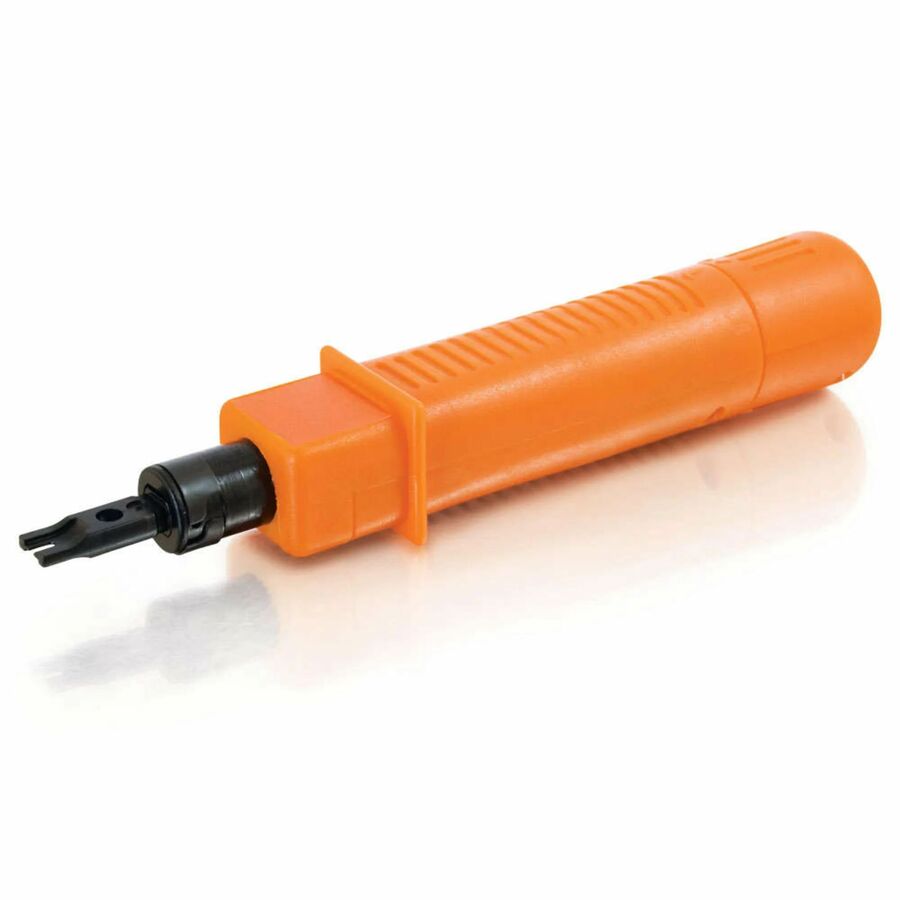
C2G 110 Impact Punchdown Tool
CG05955
C2G 110 impact punchdown tool in nickel-chrome molybdenum, with interchangeable blades and an on-board blade storage compartment.
Blades wear; a dull blade leaves conductors proud of the contact, which is the classic intermittent fault.
$58.46*Back-orderedFrequently asked
- What is the difference between a 110 block and a 66 block?
- Both use insulation-displacement contacts, but they belong to different eras and different jobs. The 110 style is the structured-cabling block — it is what carries current Category ratings, and it is what sits behind patch panels and keystone jacks. The 66 block was built for analog telephone distribution in 25-pair columns and remains a voice and legacy part. Impact tools take interchangeable 110 and 66 blades because both are still in service.
- Do you have to strip the wire before punching it down?
- No — that is the point of an insulation-displacement contact. The contact is a slot narrower than the conductor, and pressing the wire into it slices the insulation aside and makes a gas-tight metal-to-metal joint under spring pressure. Stripping the wire first actually makes the joint worse, because the insulation is part of what the contact grips.
- What does a punch-down tool do?
- It presses each conductor down into its contact with a controlled impact, and on the 110 side it also cuts the excess conductor flush in the same stroke — Panduit's instructions describe the PDT110 and the five-pair PDT110M as seating and cutting the pairs to length. Keeping the tool perpendicular to the base is what produces a consistent termination.
- How many pairs does a 110 block hold?
- The base is normally 100 pairs, and it is filled with smaller connecting blocks punched down over the wired strips. Panduit supplies those connecting blocks in 3, 4 and 5-pair widths, so a 100-pair base can be made up as five 5-pair blocks, five 4-pair blocks plus one 5-pair, or seven 3-pair blocks plus one 4-pair — whatever the cable count needs.
Sources
Keep reading