
Short answer
The main difference is that Cat6a is a recognised category with a standard RJ45 connector and 10GBASE-T specified over it to 100 m, while Cat7 is an ISO/IEC Class F cable whose rated performance needs a specialty outlet such as TERA or GG45. Specify Cat6a for horizontal runs: the extra Class F headroom carries no faster application, and past 10 Gigabit the copper path is Cat8.
Key facts
- Cat6a and Class F both top out at the same Ethernet application: 10GBASE-T over a 100 m channel.
- IEEE 802.3bq specifies 25GBASE-T and 40GBASE-T over up to 30 m of balanced twisted-pair — Category 8, not Class F.
- Class F and Class FA are ISO/IEC classes, and the standard names no connector: the two accepted Class FA outlets are TERA and GG45, not the RJ45.
- Convert a Class FA connector to an RJ45 and the channel falls to the lowest common denominator — an RJ45 at Cat6a performance limits the whole system.
- Cat6a is recognised in both unscreened and screened constructions, so shielding is not a reason to leave the category.
This comparison shows up in a very specific way: someone is writing a cabling specification, sees a higher number on a product page, and asks whether paying for it buys anything. The number is real — Class F cable is rated to 600 MHz against Cat6a's 500 — but the number is not the decision. What decides it is that Cat6a is a recognized ANSI/TIA category with a standard RJ45 connector and a 10-Gigabit Ethernet application specified over it to the full 100 meters, and Cat7 is an ISO/IEC class that TIA never recognized, whose rated performance depends on a connector most US buildings have never installed.
That connector is the crux. Full Class F performance requires a GG45, TERA or ARJ45 outlet rather than the ordinary 8P8C jack, and those systems come from a small number of manufacturers with their own patch cords, panels and termination practice. The moment a Class F cable is terminated to a normal RJ45 — which is what almost every 'Cat7 patch cable' on a marketplace actually is — the channel is limited by the connector and performs at roughly Cat6a. You have bought a stiffer, heavier, more expensive cable and a category you cannot certify.
The other half of the honest answer is what comes next. Class F's extra headroom carries no faster Ethernet application than Cat6a does; when IEEE specified 25 and 40 Gigabit over copper, it went to Category 8 over a 30-meter channel, not to Class F or Class FA. So the real fork is not 6a against 7. It is Cat6a for horizontal runs in the building, and Cat8 for the short, high-rate links inside a data-center rack.
At a glance
Side by side
| Factor | Cat6a | Cat7 (Class F) |
|---|---|---|
| Standards recognition | ANSI/TIA-568 category and ISO/IEC Class EA — recognized in both | ISO/IEC Class F only; TIA has never recognized Category 7 |
| Rated bandwidth | 500 MHz | 600 MHz (Class FA / Cat7a: 1000 MHz) |
| Connector for rated performance | Standard RJ45 (8P8C), from every manufacturer | GG45, TERA or ARJ45 — a specialty outlet, not an RJ45 |
| Behavior on an ordinary RJ45 | Full rated performance | Channel caps at roughly Cat6a; the connector is the limit |
| Fastest Ethernet application | 10GBASE-T to 100 m (IEEE 802.3an) | 10GBASE-T to 100 m — the extra headroom buys no faster application |
| Path beyond 10 Gigabit | Cat8 (Class I/II), 25/40GBASE-T over a 30 m channel | None; IEEE 802.3bq went to Cat8, not to Class F or FA |
| Shielding | Your choice — UTP or F/UTP, both within the category | Always fully shielded S/FTP with individually screened pairs |
| Bonding and grounding | Required only if you specify a screened build | Mandatory end to end; an unbonded shield is a liability, not a feature |
| Ecosystem and field testing | Jacks, panels, cords and testers everywhere; certifies to a named category | Specialty parts and skills; an RJ45 termination cannot be certified to Class F |
| Installed cost per drop | Higher than Cat6, and the mainstream choice at that price | Higher again, plus specialty outlets and slower terminations |
Choose Cat6a when
- The run is ordinary horizontal cabling in a US building and has to carry 10GBASE-T to the full 100 m channel
- You want every jack, patch panel, cord and field tester in the ecosystem to fit without a special order
- The environment is electrically noisy or the bundles carry dense high-wattage PoE, and you want shielding — F/UTP Cat6a gives you that inside the recognized category
- The installation carries a manufacturer channel warranty, which is written against recognized categories and a certified test result
- Anyone who maintains the plant after you should be able to buy a replacement cord from any distributor
Consider Cat7 only when
- The project is specified to ISO/IEC Class F by a design authority that also specifies the GG45 or TERA connector system with it
- You are extending an existing Class F plant like for like, and the outlets already installed are Class F outlets
- A genuinely hostile electrical environment has been shown to need individually screened pairs, and the installer is equipped to terminate and bond them properly
- Someone in the chain can certify the finished channel to Class F — if the plan ends in an RJ45, the category on the box is unprovable
Bottom line
For a US enterprise or public-sector building, specify Cat6a. It is recognized by TIA and ISO, it terminates to the RJ45 that every jack, panel, cord and tester in the market is built around, it carries 10GBASE-T to the full 100 meters, and it is available shielded when the environment calls for it — which is the one legitimate reason people reach for Cat7 in the first place. Class F is not a fraud and it is not bad cable; it is an ISO class whose rated performance depends on a connector the US market never adopted, which is why a 'Cat7' cable terminated to an ordinary RJ45 performs at Cat6a and cannot be certified as anything else. The headroom also leads nowhere: no Ethernet application requires Class F, and the standards body took 25 and 40 Gigabit over copper to Category 8 across a 30-meter channel instead. If the question behind the question is future-proofing, the honest answer is Cat6a in the horizontal and Cat8 where the short, fast links live, with fiber for anything that has to go further than copper sensibly goes.
Products for this decision
Horizontal runs
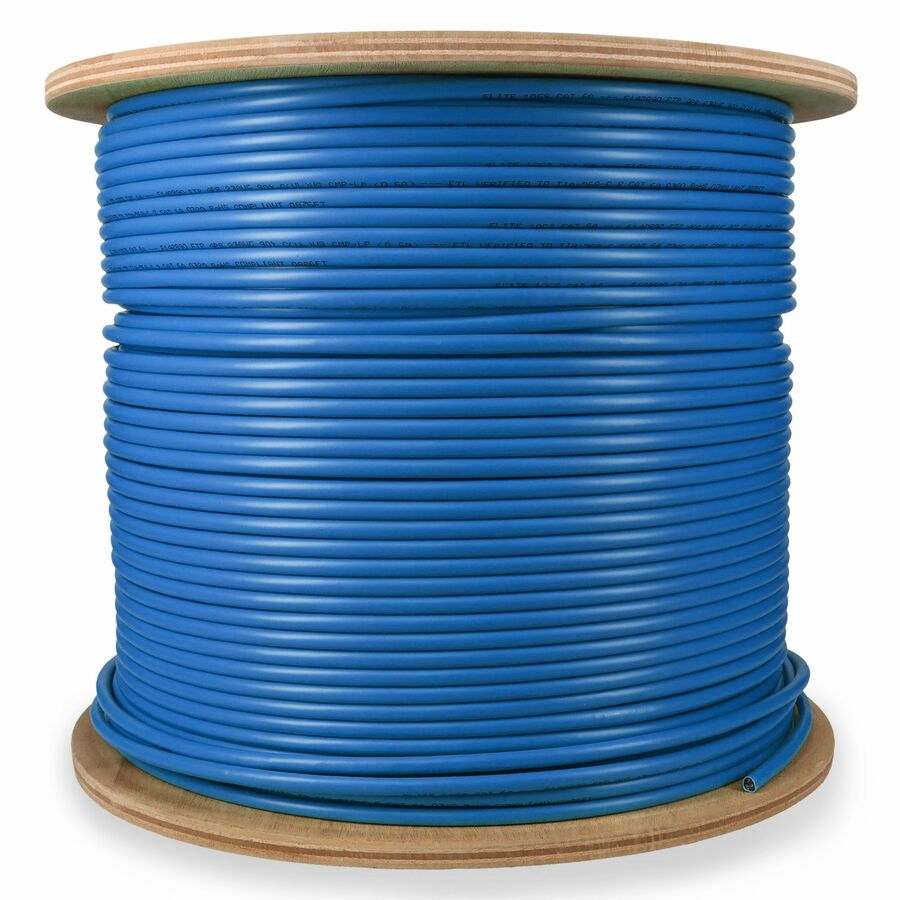
AddOn
AddOn 1000ft Non-Terminated Blue CAT6A Shielded Plenum-Rated Bulk Cable…
ADD-CAT6A1KSP-BE
A 1,000 ft box of shielded, plenum-rated 24 AWG Cat6a bulk cable, non-terminated — the horizontal cable a 10GBASE-T plant is pulled from.
Plenum rating is a building-code question for the space it runs through; confirm it against the plan before ordering.
$1,898.88Back-orderedShielded patch cord
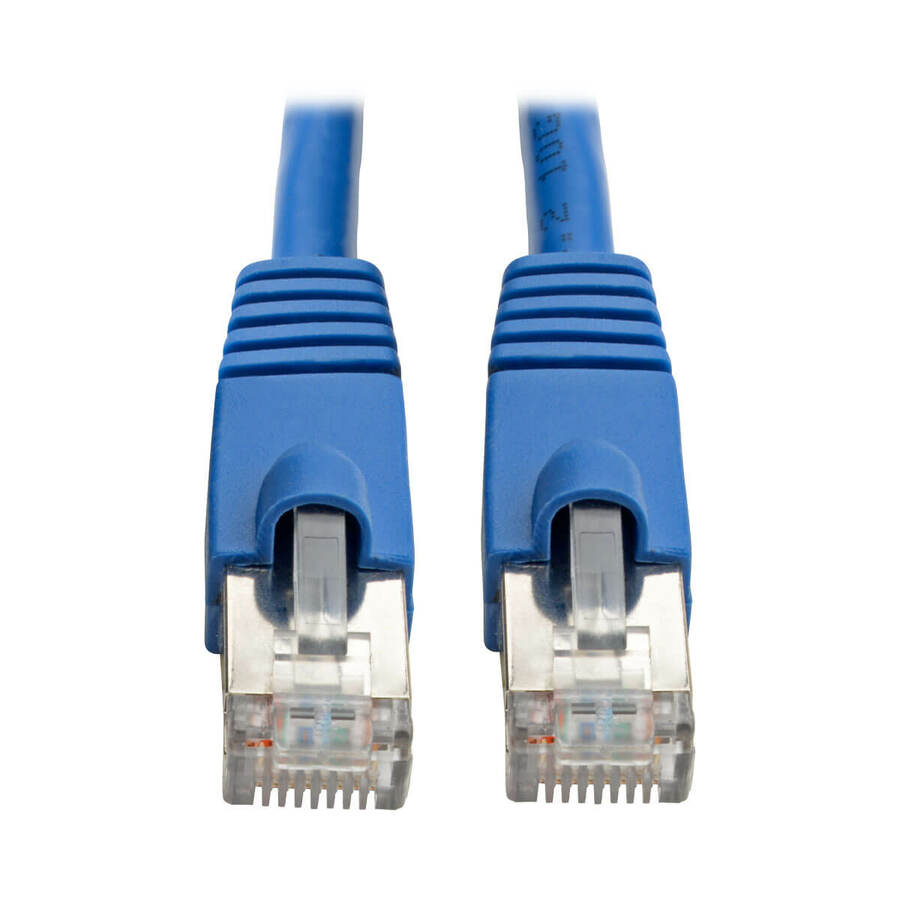
Eaton
Tripp Lite by Eaton Cat6a 10G Snagless Shielded STP Ethernet Cable…
N262-010-BL
A 10 ft shielded Cat6a patch cord with ordinary RJ45 ends — the answer when shielding is what someone reached for Cat7 to get.
$30.64In stockPast 10 Gigabit
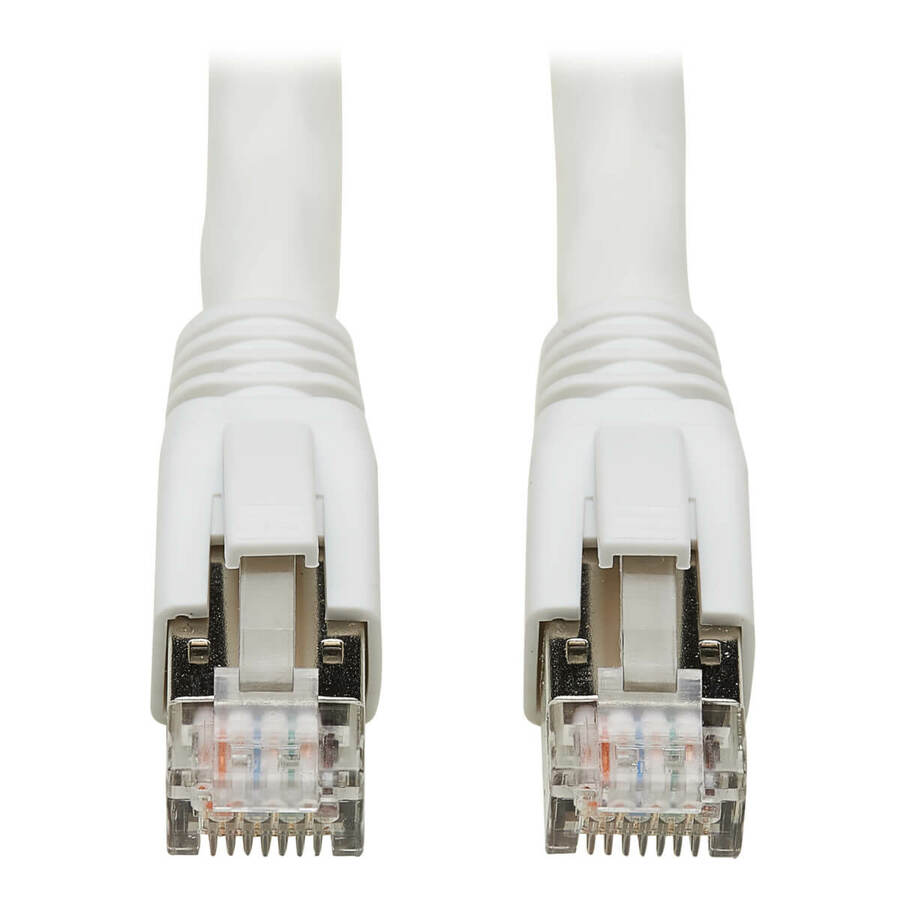
Eaton
Tripp Lite by Eaton Cat8 25G/40G Certified Snagless Shielded S/FTP…
N272-010-WH
A 10 ft shielded S/FTP Cat8 cord for the short in-rack links 25GBASE-T and 40GBASE-T were specified over, where the channel is 30 m rather than 100.
$74.41*In stockFAQ
Common questions
- Is Cat7 better than Cat6a?
- On a datasheet it looks that way — 600 MHz against 500, and fully shielded pairs — but the comparison does not survive contact with a real installation. Class F only reaches its rated performance on a GG45, TERA or ARJ45 outlet, and a Class F cable terminated to an ordinary RJ45 performs at roughly Cat6a. More to the point, no Ethernet application asks for the extra headroom: 10GBASE-T to 100 meters is the ceiling for both, and the faster copper standards were specified over Category 8 instead. Cat6a delivers the same application on hardware everyone stocks.
- Why is Cat7 not recognized in the United States?
- Because ANSI/TIA-568, the structured-cabling standard US designs are written to, recognizes Categories 5e, 6, 6A and 8 for data applications and has never included Category 7 or 7A. Class F and Class FA are ISO/IEC 11801 constructs, and they were defined around connector systems other than the RJ45. That is a standards-body divergence rather than a quality judgment, but it has a practical consequence: a US specification that calls for Cat7 is calling for something the governing standard does not define, and the test report at handover will have nothing to certify against.
- What about the Cat7 patch cables sold with RJ45 connectors?
- They are shielded cables with an RJ45 on each end, and the RJ45 is what sets the performance of the channel. The cable inside may well be built to Class F, but the connection is not, so what you have is a Cat6a-class link in an expensive, stiff jacket. There is no field tester that will certify that assembly as Category 7, because the category is a property of the whole channel and not of the spool. If shielding is what you are after, buy a shielded Cat6a cord and get a result you can certify.
- I need shielded cable. Does that mean Cat7?
- No. Cat6a is available as F/UTP and as fully shielded constructions, so you can specify shielding without leaving the recognized category or the RJ45 ecosystem. What matters far more than which category you pick is that a shielded system is only as good as its bonding: the shield has to be continuous and bonded to the telecommunications grounding system at the right points, and a screened plant that is grounded at both ends by accident or at neither end at all performs worse than a well-installed unshielded one. Decide on shielding as an environment question, then buy it in Cat6a.
- What should I specify if I need more than 10 Gigabit over copper?
- Category 8, and expect a short channel. IEEE 802.3bq specified 25GBASE-T and 40GBASE-T over Class I and Class II cabling with a reach of about 30 meters and two connectors, which places it squarely inside a data-center rack or a row, not in horizontal cabling to a work area. For anything longer than that at those rates the answer is fiber. Cat7 and Cat7a are not on this path at all — the headroom exists on paper, but the applications were never written for it.
- What is the difference between Cat7 and Cat8?
- Cat8 is a recognised ANSI/TIA category with a real application behind it; Cat7 is an ISO/IEC class with none of its own. IEEE 802.3bq specified 25GBASE-T and 40GBASE-T over up to 30 metres of balanced twisted-pair, and that is Category 8 cabling — Class F was not the path. Cat8 also keeps the RJ45, so it terminates and certifies with ordinary hardware. The two are not competitors: Cat8 lives inside a rack, and neither belongs in horizontal cabling to a work area.
- Cat6, Cat6a or Cat7 — which should I install?
- Cat6a, in almost every new build. Cat6 carries 10GBASE-T only over a shortened reach of roughly 37 to 55 metres, so it is the choice when the plant runs 1G to 5G and the runs are short. Cat6a carries 10GBASE-T to the full 100 metres and terminates to the RJ45 everything else in the market is built around. Cat7 is not a third rung above those two — it is an ISO class whose rated performance needs a connector the US market never adopted, and it reaches no faster application than Cat6a does.
Sources
- 1.IEEE 802.3an-2006 — 10GBASE-T over up to 100 m of balanced twisted-pair structured cablingstandards.ieee.org
- 2.IEEE 802.3bq-2016 — 25GBASE-T and 40GBASE-T over up to 30 m of balanced twisted-pairstandards.ieee.org
- 3.Excel Networking — Category 6, 6A and Category 7A (ISO Class Fa): a comparisonexcel-networking.com
- 4.Siemon — TERA Category 7A / Class FA shielded cabling systemsiemon.com