
Short answer
AI inference is the run-the-model phase: a finished model takes new input and produces an output, without changing its own weights. Training updates weights over a fixed dataset once; inference runs them forward on every request, for the life of the deployment. For a language model that happens in two stages — a prefill pass over the whole prompt, then a decode loop emitting one token at a time.
Key facts
- Training changes the model's weights; inference never does. That is why the machine that trains a model is often not the one that serves it.
- LLM inference runs in two stages: prefill processes the entire prompt in parallel, then decode generates one token per step, reusing a growing key-value cache.
- Prefill is compute-bound and decode is memory-bandwidth-bound, which is why the two stages scale differently and why batching helps one more than the other.
- Capacity is three numbers, not one: throughput in requests or tokens per second, latency at the p95 or p99 tail, and watts per rack unit.
- The model and its working state must fit in accelerator memory. A language model's key-value cache grows as it generates, so memory often binds before compute.
- A GPU is not always required. Smaller models, classical machine learning and bursty traffic run acceptably on the CPU every server already has.
By Uniqcli Team
AI inference is the phase in which a trained machine-learning model is put to work: it takes new, previously unseen input and produces an output — a prediction, a classification, a generated sentence, or a detected object. It is the run-the-model stage, and it is distinct from training, the earlier and usually one-time process of building the model by adjusting its internal parameters against large datasets. Once a model has been trained, every time it answers a question, transcribes audio, flags an anomaly, or drafts a paragraph, it is performing inference.
For most organizations, inference — not training — is the workload that actually shapes a hardware purchase. Comparatively few teams train large models from scratch; the overwhelming majority take a pre-trained or fine-tuned model and run it in production, sometimes millions of times a day. That makes "how much inference can this hardware deliver" the practical buying question, and it is answered in three currencies: throughput (how many requests or tokens per second), latency (how quickly a single response comes back), and power (how many watts each unit of that work costs in a rack). Sizing inference capacity against those three numbers, rather than against a single headline specification, is what keeps a deployment both responsive and affordable to run.
AI inference vs training: what's the difference?
Training and inference are two phases of a model's life, and they stress hardware in opposite ways. Training builds the model: it repeatedly runs data through the network and adjusts millions or billions of parameters until the model's outputs are accurate. It is computationally enormous, typically runs on large multi-accelerator clusters, tolerates long runtimes measured in hours to weeks, and is done once or on a periodic schedule. Inference uses the finished model: it feeds in new input and reads out a result, with no parameter updates, and it runs continuously for the entire life of the deployment. Where training is a scheduled, capital-heavy effort, inference is an ongoing operating cost that recurs with every request.
That difference is why the hardware that trains a model is rarely the hardware that serves it. Training is throughput-bound and batch-friendly — you can wait for a long job to finish — so it rewards raw compute concentrated in big clusters. Inference is frequently latency-sensitive, because a user or a mission system is waiting for the answer, so it rewards fast, efficient response on a much smaller footprint. A model trained across dozens of accelerators may be served on a single card, on a CPU, or on a compact edge device. For the majority of buyers who consume pre-trained models rather than build them, it is this serving footprint — not the training cluster — that they actually budget for, deploy, and scale.
How does AI inference work?
Inference is a forward pass through the model. The input is first encoded into numbers — tokens for text, tensors for images or audio — and those numbers flow through the network's layers a single time, producing an output at the end. No weights change. For generative and large-language models, the output is produced token by token, with each new token conditioned on the ones already generated, which is why a long response takes longer than a short one and why the time to the first token and the steady per-token rate are measured as separate figures.
Two levers dominate real-world inference performance: precision and batching. A model can be served at reduced numerical precision — FP16 or BF16, or quantized further to INT8 or INT4 — which shrinks its memory footprint and speeds up computation with limited accuracy loss, and it is a common way to fit a large model onto smaller hardware. Batching groups concurrent requests so the accelerator processes many at once, raising overall throughput at some cost to any single request's latency. Memory matters disproportionately in all of this: the model's parameters plus its working state — for language models, the key-value cache that grows as text is generated — must fit in the accelerator's memory, so memory capacity and bandwidth often bound inference more tightly than raw compute does.
Sizing inference capacity: throughput, latency, and watts
Throughput is the first number to nail down: queries per second, images per second, or, for language models, tokens per second at a stated batch size. It sets how many concurrent users or how large a workload a single node can serve, and therefore how many nodes a target load will require. Latency is the second: the time to a single response, which should be watched at a tail percentile such as p95 or p99 rather than an average, because the slowest responses are the ones users and time-critical systems actually feel. Throughput and latency trade against each other through batching, so a sound specification states both — for example, a required tokens-per-second at a maximum acceptable p99 latency — instead of one in isolation.
The third currency is watts, and the heat those watts produce. Accelerators are dense, power-hungry parts, and a rack has finite power and cooling. "Watts per rack unit," and the related measure of performance per watt, is a genuine procurement constraint: a data center often runs out of amperage or cooling capacity before it runs out of physical rack space, and in edge, vehicle, or forward deployments the power and thermal envelope can be the hard limit that decides the design. Evaluating inference on throughput per watt, not throughput alone, is what keeps both the operating cost and the facility itself sustainable as a deployment scales from a pilot to production.
Where does inference run — cloud, data center, and the edge?
Inference runs across a spectrum of locations. Centralized inference in a data center or cloud concentrates accelerators where power, cooling, and scale are available, and it is the default for the largest models and for high aggregate request volume. Edge inference instead pushes the model close to where data is created — a factory floor, a camera, a vehicle, a clinic, a forward site — to cut network round-trip latency, keep sensitive data local for privacy or bandwidth reasons, and keep working when connectivity is intermittent. The same trained model can be deployed to either environment, with the serving hardware sized to the location and its constraints.
The processor choice follows the model and the target. GPUs and dedicated AI accelerators dominate demanding inference because their massively parallel design suits the matrix math involved, and they are the standard for large language and vision models. CPUs remain perfectly capable for smaller or lighter-traffic models, classical machine learning, and workloads where an accelerator would sit mostly idle — and every server already has one. Compact edge accelerators and integrated neural processing units cover low-power, ruggedized, and embedded deployments. There is no single right answer, which is exactly why the CPU-versus-GPU decision and the edge-AI deployment pattern each deserve their own detailed treatment rather than a blanket rule.
What should you look for when buying inference hardware?
Start from the model you actually intend to serve and its memory footprint, because accelerator memory — both capacity and bandwidth — is usually the first thing that constrains inference. Confirm the model, at your chosen precision, fits in the accelerator's memory with headroom for the working state and your batch size; under-provisioning memory forces you into heavier quantization, a spill to slower memory, or a smaller model. From there, match the platform: a GPU-ready server with the power connectors, cooling, and physical slots for the accelerators you have chosen, enough system memory and fast storage to keep them fed, and the network bandwidth to move data in and results out. Data-center accelerators such as the NVIDIA L4 — a compact, low-power inference card — and the H100, a high-end data-center GPU, bracket the range, from efficient edge-friendly serving to the very largest models.
Practical sourcing realities matter as much as the specification sheet. Our working catalog carries a broad NVIDIA line — on the order of 7,800 SKUs spanning accelerators, networking, and the software and support that surround them — alongside board-partner cards such as PNY's roughly 96-SKU range, and the GPU-ready rack servers and workstations that host them. Be candid about lead times: accelerator-class hardware is in high demand, and the large majority of graphics-card listings in our catalog show a back-ordered or lead-time status rather than same-day stock, so plan procurement around that reality instead of assuming shelf availability. For federal and regulated buyers, sourcing can be screened for TAA and NDAA Section 889 considerations as part of the quote — a screening service we perform, not a certification we hold — and configurations can be validated before they ship. When a workload is defined, moving from a model's memory requirement to a costed, lead-time-honest bill of materials is the step that turns an inference plan into hardware you can actually deploy.
Key takeaways
- AI inference is the run-the-model phase — a trained model taking new input and producing an output such as a prediction, a classification, or generated text — as opposed to training, which is the earlier process of building the model.
- For most organizations inference, not training, drives the hardware decision: few teams train from scratch, while nearly everyone runs pre-trained or fine-tuned models in production.
- Inference capacity is measured in three currencies — throughput (requests or tokens per second), latency (time to a response, watched at the p95/p99 tail), and power (watts, and watts per rack unit).
- Precision (FP16/BF16 or quantized INT8/INT4), batching, and above all accelerator memory capacity and bandwidth are the levers that bound real-world inference performance.
- Inference runs across a spectrum from centralized data center and cloud to the edge; GPUs and AI accelerators suit large models, while CPUs remain fine for smaller or lighter-traffic workloads.
- When buying, size the accelerator's memory to the model first, match a GPU-ready server with the power and cooling to host it, and plan for real lead times on accelerator-class hardware.
Shop it at Uniqcli
Parts for this job
Workstation-scale
Lenovo
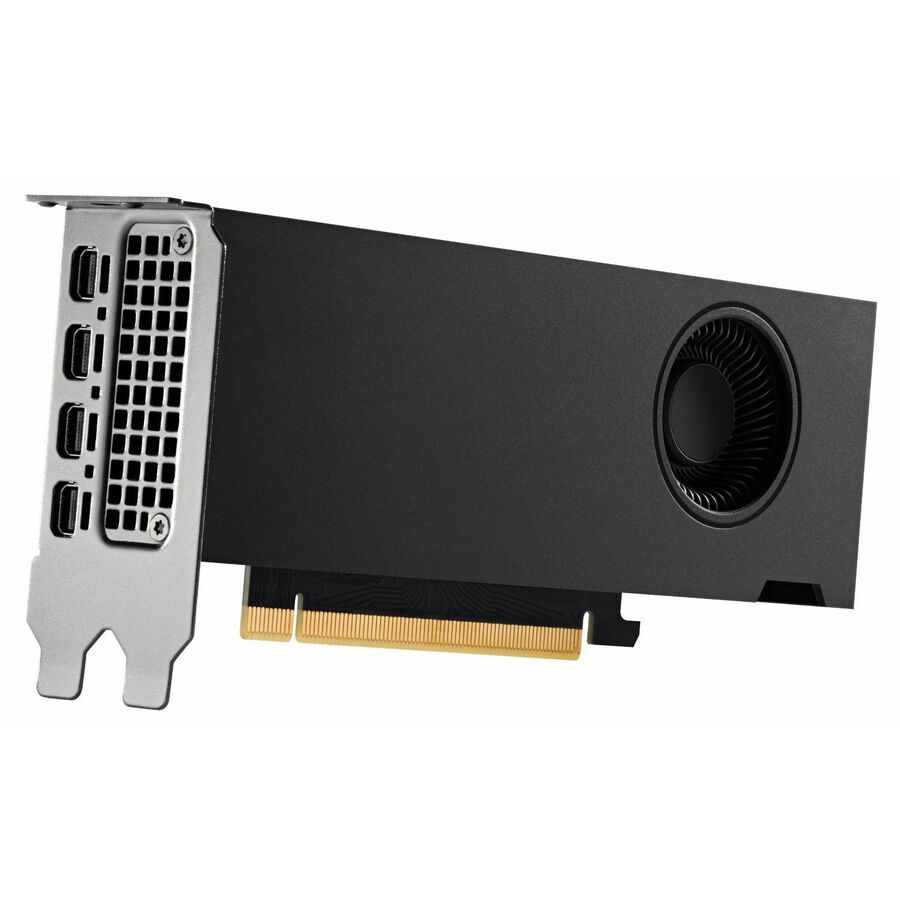
Lenovo NVIDIA RTX A2000 Graphic Card
4X67A76720
A 12 GB professional card for running a small model beside the application that calls it, on a desk rather than in a rack.
$1,841.17Back-orderedLow-profile server card
NVIDIA
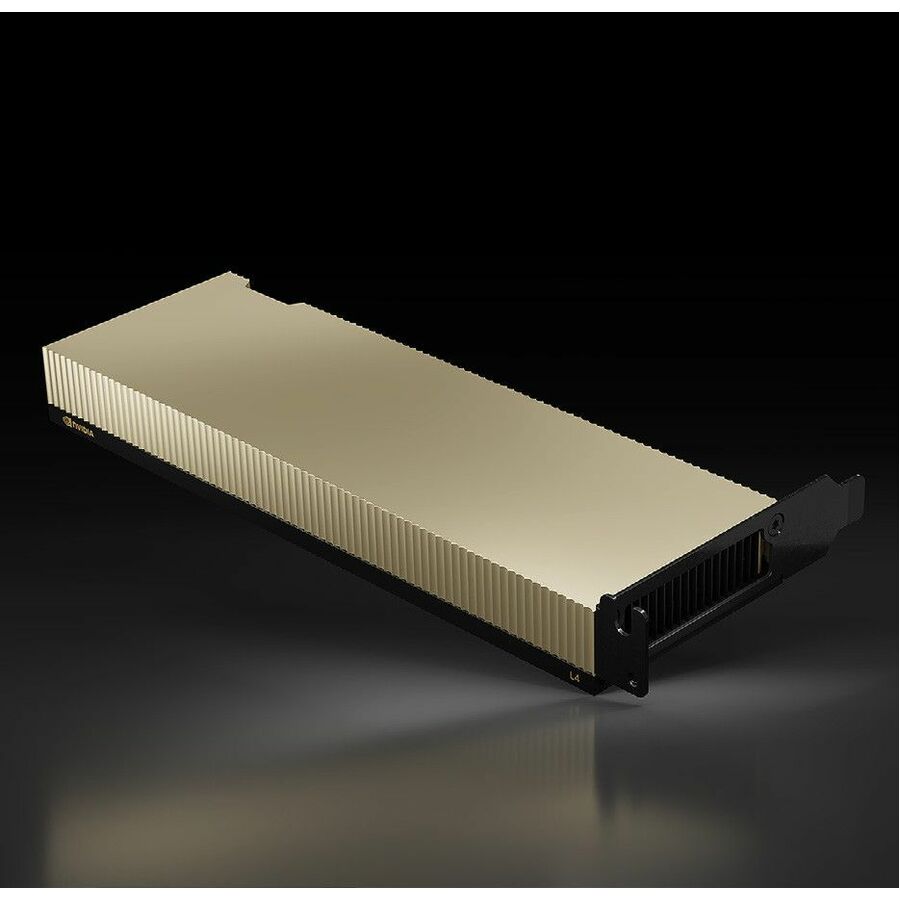
NVIDIA L4 Graphic Card
900-2G193-0000-001
The 24 GB low-profile L4 — the card sized for a compact or 1U server where slot height, power and cooling are the constraints rather than raw throughput.
$3,426.27Back-ordered48 GB, larger models
PNY Technologies
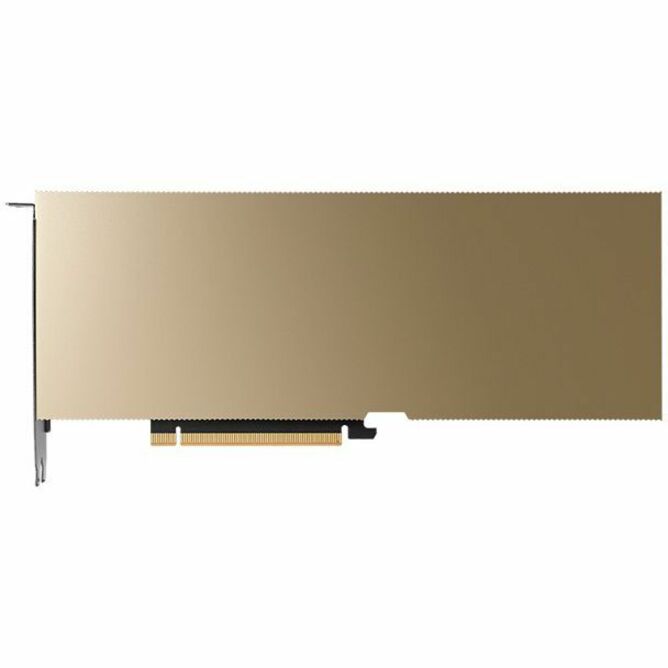
PNY NVIDIA Quadro L40S Graphic Card
NVL40STCGPU-KIT
An L40S with 48 GB, for serving a model that will not fit in 24 GB at your chosen precision, or for holding a bigger key-value cache under concurrency.
Size accelerator memory to the model at your target precision and batch size first; the rest of the sizing follows from that.
$12,745.47Back-orderedFrequently asked
- What is the difference between AI training and inference?
- Training is the one-time or periodic process of building a model by adjusting its parameters against large datasets — it is computationally enormous and usually runs on big multi-accelerator clusters over hours to weeks. Inference is running the finished model: feeding it new input and reading out an output, over and over, for the life of the deployment. Training is a scheduled, throughput-bound capital effort; inference is an ongoing, often latency-sensitive workload whose per-request cost recurs continuously. Because the two stress hardware differently, the system that trains a model is frequently not the one that serves it.
- Do I need a GPU for AI inference?
- Not always. GPUs and dedicated AI accelerators are the standard for large language and vision models because their parallel design handles the underlying matrix math efficiently, and for high-volume or low-latency generative workloads they are usually the right tool. But CPUs are perfectly capable for smaller models, classical machine learning, and lighter or bursty traffic where an accelerator would sit idle — and every server already has one. The honest answer depends on the specific model, the request volume, and your latency target; sizing those first tells you whether an accelerator is warranted.
- How do I size inference capacity for a deployment?
- Start from the workload: how many concurrent requests, and how fast each response must return. Translate that into a throughput target (requests or tokens per second) and a latency ceiling (typically at the p95 or p99 tail, not an average), remembering that the two trade off against each other through batching. Confirm the model fits in the accelerator's memory at your chosen precision, with room for batching and the working state. Then account for power and cooling — watts per rack unit is a real limit — because a facility often runs out of power or thermal headroom before it runs out of physical space.
- Why is memory so important for AI inference?
- A model's parameters, plus its working state during a request, have to reside in the serving hardware's memory to run efficiently. For large models — and especially for language models, whose key-value cache grows as they generate text — memory capacity and bandwidth frequently constrain inference more than raw compute does. If a model does not fit, you are forced to quantize to a lower precision, spill to slower memory, or choose a smaller model. That is why matching accelerator memory to the model you intend to serve, at your target precision and batch size, is usually the first sizing step.
- What is the difference between LLM training and inference?
- Training builds the model by adjusting billions of weights against a fixed dataset, once, on a large cluster over hours to weeks. Inference runs those finished weights forward on every new prompt and never changes them. For a language model, inference itself has two stages: a prefill pass that processes the whole prompt at once, then a decode loop that emits one token at a time while reusing a key-value cache. Prefill is compute-bound, decode is memory-bandwidth-bound, and neither resembles the sustained all-reduce traffic of a training run.
- Can you give me an example of AI inference?
- Every time a model answers rather than learns. A camera model classifying a package on a conveyor, a transcription model turning a call into text, a fraud model scoring a transaction as it clears, a chat assistant generating a reply token by token — all four are inference, running weights that were fixed weeks or months earlier. The tell is that nothing about the model changes: the same input would produce the same output tomorrow.
- How expensive is LLM inference?
- It is a recurring cost rather than a capital one, and it is set by three things: how many tokens you generate, how fast each response has to come back, and how much accelerator memory the model needs at your chosen precision. Latency and cost trade off directly — larger batches raise tokens per second per card and raise the tail latency each user feels. Size the deployment against a real throughput target and a p95 latency ceiling, then price the power as well as the hardware, because watts per rack unit is a limit facilities hit before they run out of space.
Sources
- 1.NVIDIA — mastering LLM techniques: inference optimizationdeveloper.nvidia.com
- 2.NVIDIA — large language models explainednvidia.com
- 3.NVIDIA — L40S GPUnvidia.com
Keep reading