
Short answer
SASE (secure access service edge) delivers wide-area routing and security services from one cloud edge, so branch traffic is inspected where it exits instead of being hauled back to a data centre first. The industry service definition is MEF 117. SD-WAN is the transport half of SASE; SSE is the security half without the steering.
Key facts
- MEF 117 is the industry standard covering SASE service attributes and the SASE service framework. MEF 117.1 followed in June 2025.
- That framework groups a SASE service into connectivity, cybersecurity and edge components — it is a service definition, not a single product.
- SD-WAN sits on the connectivity side of the framework and inspection on the cybersecurity side, which is why the two terms are not interchangeable.
- Zero-trust network access, one of those security functions, follows the model in NIST SP 800-207: each request judged against identity and device state.
By Uniqcli Team
Secure access service edge (SASE, usually said 'sassy') describes an architecture in which network connectivity and network security are delivered together as a distributed service rather than assembled from separate appliances at each location. Instead of hauling traffic back to a central firewall before it reaches the internet, every user and every site connects to a nearby point of presence in the provider's fabric, where identity is checked, policy is applied and inspection happens — and the traffic then goes directly to wherever it was going.
The word to notice is architecture. SASE is not a device, a protocol or a standard; it is a description of how several established functions are packaged and where they run. The functions themselves are familiar — traffic steering across multiple links, a secure web gateway, controls over cloud application use, per-application remote access, firewalling — and each has its own long history as a box in a rack. What changed is that they are being sold as one cloud-delivered platform with one policy model and one identity source.
That has real consequences and it also generates a lot of noise, because the term is broad enough that almost any security portfolio can be labeled with it. This page describes what the architecture contains, which parts of a site it genuinely removes and which it does not, and the specific questions worth asking of any proposal that carries the name.
What SASE bundles
Five capabilities appear in nearly every definition. Software-defined wide-area networking steers traffic across whichever links a site has, from central policy. A secure web gateway inspects and filters outbound web traffic, applying URL and category policy, malware scanning and increasingly content controls. A cloud access security broker governs use of software-as-a-service applications — which ones, by whom, and what data may move into and out of them. Zero-trust network access replaces the traditional remote-access VPN with per-application authorization based on identity and device state. Firewall-as-a-service provides the stateful and application-aware filtering that used to be a branch appliance.
Around those five, platforms add functions that are easier to run centrally than per site: DNS-layer filtering, inline data loss prevention, remote browser isolation, sandboxing of downloads, and inspection of traffic to and from cloud infrastructure. None of these are new capabilities. What is new is that a single policy expressed once — this group of people, on devices in this condition, may reach these applications under these conditions — is enforced across all of them rather than restated in five consoles.
You will also meet SSE, security service edge, which is the same platform without the network steering: the security half on its own, for organizations that already have a wide-area network they are not replacing or that intend to keep those two decisions with different suppliers. That split is the most useful distinction in the vocabulary, because it separates a networking project from a security one, and many buyers only need the second.
How the traffic actually flows
The fabric is a set of points of presence — data centers around the world running the provider's inspection stack. A branch site connects to the nearest one over an encrypted tunnel from its edge appliance; a remote user connects through a lightweight agent on the laptop; a cloud environment connects through a virtual instance or a peering arrangement. Once traffic is inside the fabric, policy is applied at that point of presence and the traffic egresses toward its destination from there.
Two properties follow from that shape. The first is that inspection stops being a capacity problem at each site — a small office and a large one get the same policy and the same inspection depth, because the work is done in a facility sized for it. The second is that latency now depends on the distance to the nearest point of presence, which makes the provider's map of them a genuine technical criterion rather than a marketing slide. Ask where the points of presence serving your actual locations are, and test from those locations rather than from headquarters.
TLS inspection is the specific thing to plan around. Most of the security value of a web gateway or inline data-loss control requires decrypting traffic, which means the fabric holds a certificate that every managed device trusts, and it means applications that pin certificates will break until they are excluded. That is manageable, and it is a project of its own — certificate distribution, an exclusion list that has to be maintained, and a documented position on which categories of traffic are never decrypted, such as banking and health. Deciding all of that after go-live is the usual reason a rollout stalls.
What still lives in the building
A cloud security fabric does not empty the comms room. Each site still needs an edge device to terminate its links and build the tunnels into the fabric — usually the SD-WAN appliance, sometimes a router with the provider's software on it — and that device is sized by encrypted throughput with the features you will actually enable, not by port count. Sites that must stay up through a hardware failure need two of them, which is a per-site decision rather than an estate-wide one.
Below that, nothing changes: access switches, PoE for phones, cameras and access points, the wireless infrastructure itself, structured cabling and patching, the rack, and power protection for all of it. If anything, a design that depends on reaching a cloud fabric raises the importance of the local plant, because a site with a single uplink and no battery behind the switch now loses its security policy along with its connectivity. Cellular failover as a second path is a common and inexpensive answer, and it is a hardware line item.
The other on-premises reality is what does not go through the fabric at all. Traffic between devices inside a site — a workstation to a local server, a scanner to a print server, industrial equipment to a controller — never leaves the building, and no cloud-delivered control sees it. That traffic is still governed by segmentation on the switches and by network access control at the port, which is why a SASE program usually runs alongside those rather than replacing them.
Identity is the control plane
The distinguishing idea, and the one that separates a real SASE deployment from a set of cloud-hosted appliances, is that access decisions are made from identity and context rather than from network position. Every request carries a user, a device and a set of conditions — is the device managed, is it compliant, where is it, what is being asked for — and policy evaluates all of them each time rather than granting a network address and trusting whatever comes from it afterwards.
That is the same principle NIST Special Publication 800-207 sets out for zero-trust architecture: an explicit, per-request access decision made by a policy engine, informed by device state and continuously re-evaluated. CISA's Zero Trust Maturity Model describes the same target across its pillars and is the reference most public-sector programs are measured against. SASE is one delivery model for parts of that — chiefly the network and, through zero-trust network access, the application pillar — and it is not the whole of it. Identity governance, device management and data protection sit outside the fabric and have to be delivered by something.
The practical implication is that the identity provider becomes the most load-bearing system in the design. Multi-factor authentication, conditional access rules, group hygiene and device-compliance signals are what the policy is actually made of, and a fabric applying rich policy on top of a poorly maintained directory produces confident enforcement of the wrong thing. Anyone whose group memberships are three reorganizations out of date should fix that before it starts governing network access.
Single-vendor, dual-vendor, and what a proposal is really offering
A single-vendor platform delivers the network and security halves from one stack, with one policy model, one console and one place to call. The integration is genuine and so is the coupling: replacing any component later means unpicking the whole. A dual-vendor approach pairs a network platform with a separate security service edge, which preserves choice on both sides and costs integration effort and, on a bad day, an argument about whose problem the latency is.
The question that cuts through most proposals is which components are actually included at the tier being quoted, and where each one runs. It is common for a bundle to include the network steering and a web gateway while zero-trust network access, cloud application controls, data loss prevention and sandboxing are separate line items — or included at a tier above. Ask for the component list against the license, not against the platform, and ask which of them are the vendor's own code and which are acquisitions still being integrated, because a shared console is not the same as a shared policy engine.
Then price the whole thing honestly. Licensing is typically per user, sometimes per site or per bandwidth tier, and it is recurring; the appliances are capital; the circuits are ordered separately from whichever providers serve each location, and their lead times, not the platform's, set the schedule. Appliances, subscriptions and staging can be quoted on one document so the capital and recurring halves are visible together — which is worth doing, because a budget built from the hardware line alone will be wrong by a large multiple.
Questions to settle before signing
For public-sector buyers, start with authorization status. A cloud-delivered security service processes the organization's traffic, so whether the platform holds a FedRAMP authorization at the impact level the data requires is a threshold question rather than a detail, and it varies by component within a vendor's own portfolio — the web gateway and the zero-trust access service are not always authorized together. Ask per component, and ask which government environment the traffic actually lands in.
Then settle the failure behavior, because it is the question most likely to be skipped and most likely to matter. If a site cannot reach the fabric, does the edge device fail open and let traffic out unprotected, fail closed and take the site offline, or fall back to a local policy set? Each is defensible in different places, and the wrong default discovered during an outage is expensive. Ask the same question for the endpoint agent when a laptop is somewhere the fabric is unreachable.
Finally, the boring commercial ones that decide how the next five years go. Where telemetry and logs are stored and for how long, and whether you can export them. What the contract term is and what renewal looks like when the platform is load-bearing for connectivity as well as security. Whether the policy model can be exported in any form if you leave. And what happens operationally on the day the platform's own certificate authority, agent or policy push has a bad release — because when the network path and the security policy come from the same supplier, a single incident reaches further than it used to.
Key takeaways
- SASE is an architecture, not a product: network steering and network security delivered together from a distributed cloud fabric instead of assembled from appliances at each site.
- The usual component list is SD-WAN, a secure web gateway, a cloud access security broker, zero-trust network access and firewall-as-a-service, with DNS filtering, inline DLP and isolation added around them.
- SSE — security service edge — is the same platform without the network steering, which is the right scope when the wide-area network is not being replaced.
- Traffic reaches a nearby point of presence, is inspected there and egresses from there, so the provider's map of points of presence near your actual sites is a technical criterion worth testing.
- TLS inspection is where the security value is and where the work is: certificate trust on every managed device, a maintained exclusion list for pinned applications, and a stated position on categories that are never decrypted.
- The comms room does not empty — edge appliances, switching, PoE, wireless, cabling and power protection all remain, and cellular failover matters more once security policy depends on reaching a cloud fabric.
- Access decisions come from identity and device state, which makes the identity provider the most load-bearing system in the design; NIST SP 800-207 and CISA's Zero Trust Maturity Model are the reference points.
- For public-sector buyers, FedRAMP authorization varies by component within one vendor's portfolio, and the fail-open or fail-closed behavior when the fabric is unreachable should be settled before signature.
Shop it at Uniqcli
Parts for this job
Small branch edge
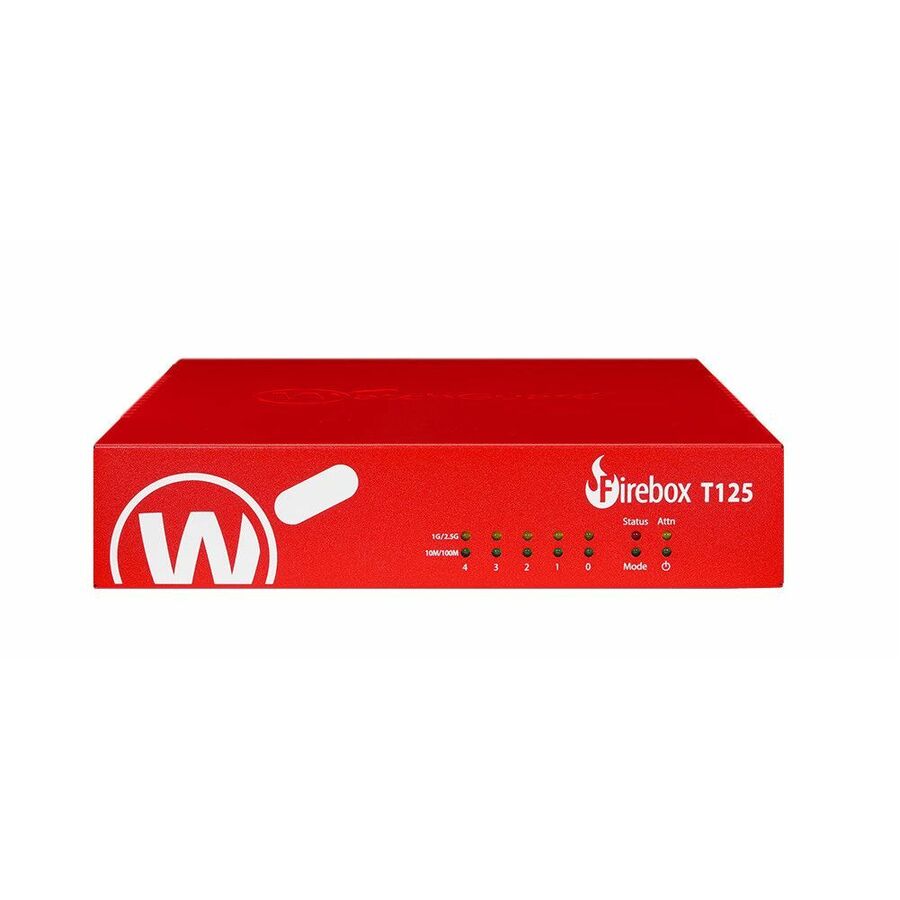
WatchGuard Technologies
WatchGuard Firebox T125 Appliance Only
WGT125000
A five-port appliance rated 2.28 Gbit/s firewall throughput with 2.5 GbE ports — the box that terminates a small site's links whatever the cloud service above it is.
$242.66In stockBranch edge with wireless
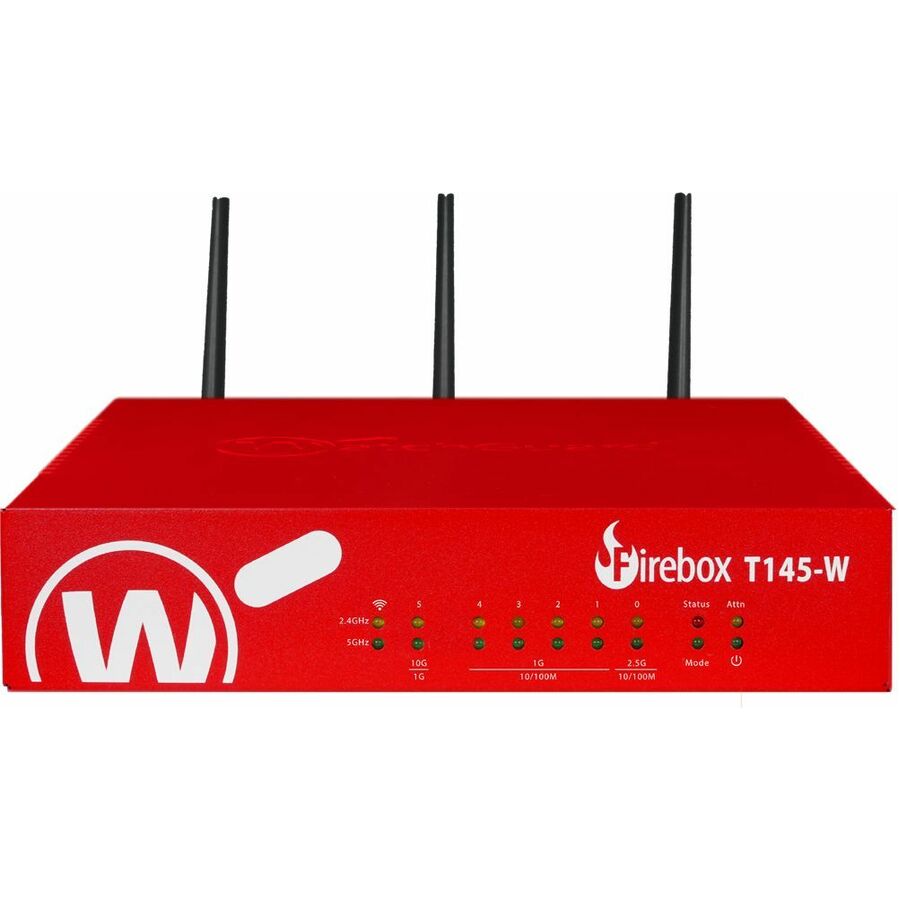
WatchGuard Technologies
WatchGuard Firebox T145-W Appliance Only
WGT146000
A five-port appliance rated 3.90 Gbit/s firewall throughput with 802.11be wireless and an expansion slot, for a site that wants one device at the demarcation.
Appliance only. Cloud security services are licensed separately by the vendor.
$410.66In stockFrequently asked
- What is the difference between SASE and SD-WAN?
- SD-WAN is one component of SASE. It handles transport — steering traffic across whichever links a site has, from policy defined centrally — and says nothing about inspecting that traffic. SASE describes the combination of that steering with security functions delivered from a cloud fabric: web gateway, cloud application controls, zero-trust access and firewalling. Many vendors sell SD-WAN as the on-ramp to their SASE platform, so the two frequently arrive as one commercial conversation. If a proposal uses both words, the useful question is which security functions are included at the tier being quoted, where they run, and how each is licensed.
- What is the difference between SASE and SSE?
- SSE, security service edge, is the security half of SASE without the network steering — typically the secure web gateway, cloud access security broker and zero-trust network access, delivered from the same cloud fabric. SASE adds SD-WAN to that. The distinction matters commercially more than technically: it separates a security decision from a networking one. An organization that has a wide-area network it is not replacing, or that wants its network and security suppliers to be different, buys SSE. An organization refreshing both at once, and willing to accept the coupling, buys the combined platform.
- Does SASE replace our firewalls?
- It replaces some of them and not others, and the boundary is worth drawing on a diagram before anyone signs. Firewall-as-a-service can take over outbound and internet-facing filtering that a branch appliance used to do, which is where most of the estate's firewall count usually sits. What it does not touch is traffic that never leaves the site — a workstation to a local server, equipment to a controller — or the data-center boundary in front of applications you host yourself, which stays an appliance problem. Segmentation inside a site remains a job for the switches and for network access control at the port.
- Do we still need hardware at each site?
- Yes. Each site needs something to terminate its links and build the encrypted tunnels into the fabric — normally the SD-WAN appliance, sized by encrypted throughput with the features you will actually enable — and sites that must survive a hardware failure need a redundant pair. Underneath it, nothing changes: access switches, PoE for phones, cameras and access points, the wireless infrastructure, cabling and the rack, and power protection for all of it. A design that depends on reaching a cloud fabric arguably raises the importance of the local plant, which is why a second path such as cellular failover is a common line item.
- What happens if the cloud fabric is unreachable?
- That depends on a setting somebody has to choose, and it is the question most often skipped. An edge device can fail open, letting traffic out uninspected so the site keeps working; fail closed, taking the site offline rather than allowing unprotected traffic; or fall back to a reduced local policy. Each is right somewhere and disastrous elsewhere, and finding out what your default is during an outage is the expensive way to learn it. Ask the same question about the laptop agent when a remote user is somewhere the fabric cannot be reached, and confirm what the provider's own redundancy between points of presence looks like.
- Is SASE suitable for government and regulated environments?
- It can be, and the checks are specific. Because the platform inspects the organization's traffic in the provider's infrastructure, the threshold question is whether it holds a FedRAMP authorization at the impact level the data requires — and that varies by component within a single vendor's portfolio, so ask per service rather than per brand, and ask which environment the traffic lands in. Beyond authorization, settle where logs and telemetry are stored and for how long, whether they can be exported, and how the design handles categories of traffic that policy says must never be decrypted. None of that is unusual; all of it is easier to answer before signature than after.
Sources
- 1.Mplify (MEF) — SASE service standards and MEF 117mplify.net
- 2.NIST SP 800-207 — Zero Trust Architecturecsrc.nist.gov
Keep reading