
NVIDIA B200 vs B300: Which Platform Fits the Mission and Facility?
NVIDIA B300 is newer than B200, but “newer” does not answer a government deployment decision. B200 may offer a better-aligned OEM design, delivery window, software baseline and air- or liquid-cooling path. B300 offers Blackwell Ultra capabilities and more memory at the GPU generation, but its value depends on the exact server or rack form, model workload and facility readiness.
By Uniqcli Team · · 6 min read
Key takeaways
- B200 is Blackwell; B300 is Blackwell Ultra.
- B300 appears in both HGX B300 server platforms and GB300 NVL72 rack-scale systems. Those are not equivalent facility projects.
- Workload memory, deployment date and accepted software baseline should drive the choice.
- B200 can be the lower-risk choice when its design is available, validated and compatible with the site.
- B300 can be compelling for memory-intensive reasoning and dense scale, but may increase facility, integration and schedule dependencies.
- A phased acquisition can preserve near-term mission delivery while validating B300 for later capacity.
On this page
The decision should be made at the supported-system level and dated. Compare a proposed B200 configuration with a proposed B300 configuration, not two chip names floating outside a server.
Define the two proposals
Start by naming a real system on each side. A B200 proposal might be an eight-GPU OEM HGX B200 server or DGX B200 appliance. A B300 proposal might be an OEM HGX B300 server, an HGX B300 NVL16 design or a GB300 NVL72 rack. If one side is a server and the other is a rack-scale architecture, normalize the comparison around mission capacity and total deployment boundary.
Record manufacturer, model, revision, GPU count and memory, host configuration, NIC/DPU population, local storage, software entitlement, power, cooling, rack units, support and delivery assumption. Verify each combination in current NVIDIA supported-platform documentation.
The comparison date belongs at the top. B300 platform availability, firmware and OEM options can evolve quickly. A decision made in August may be wrong in December—not because the earlier analysis failed, but because its schedule and support assumptions changed.
Compare workload fit
Model memory is often the first B300 advantage a team considers. More accelerator memory can hold larger models, longer contexts, larger key-value caches or bigger batches with less partitioning. But useful capacity depends on model precision, framework behavior, concurrency and memory reserved by the runtime.
Create a representative test plan before assigning points. For training, measure step time, scaling efficiency, checkpoint time and recovery. For inference, measure throughput at the required latency, context length and concurrency. For retrieval-augmented generation, include embedding, index lookup and prompt construction rather than testing the model in isolation.
Determine whether the workload is compute-bound, memory-capacity-bound, memory-bandwidth-bound, network-bound or storage-bound. A B300 system cannot deliver its theoretical advantage if the data pipeline starves it. Conversely, buying more B200 nodes to reach a target may increase fabric ports, software licenses and rack power enough to make B300's density economically attractive.
Also identify how long the workload will remain stable. A research environment may value headroom for unknown models. A production inference service with a known model may value a mature, right-sized B200 configuration and predictable support.
Compare system form and facility risk
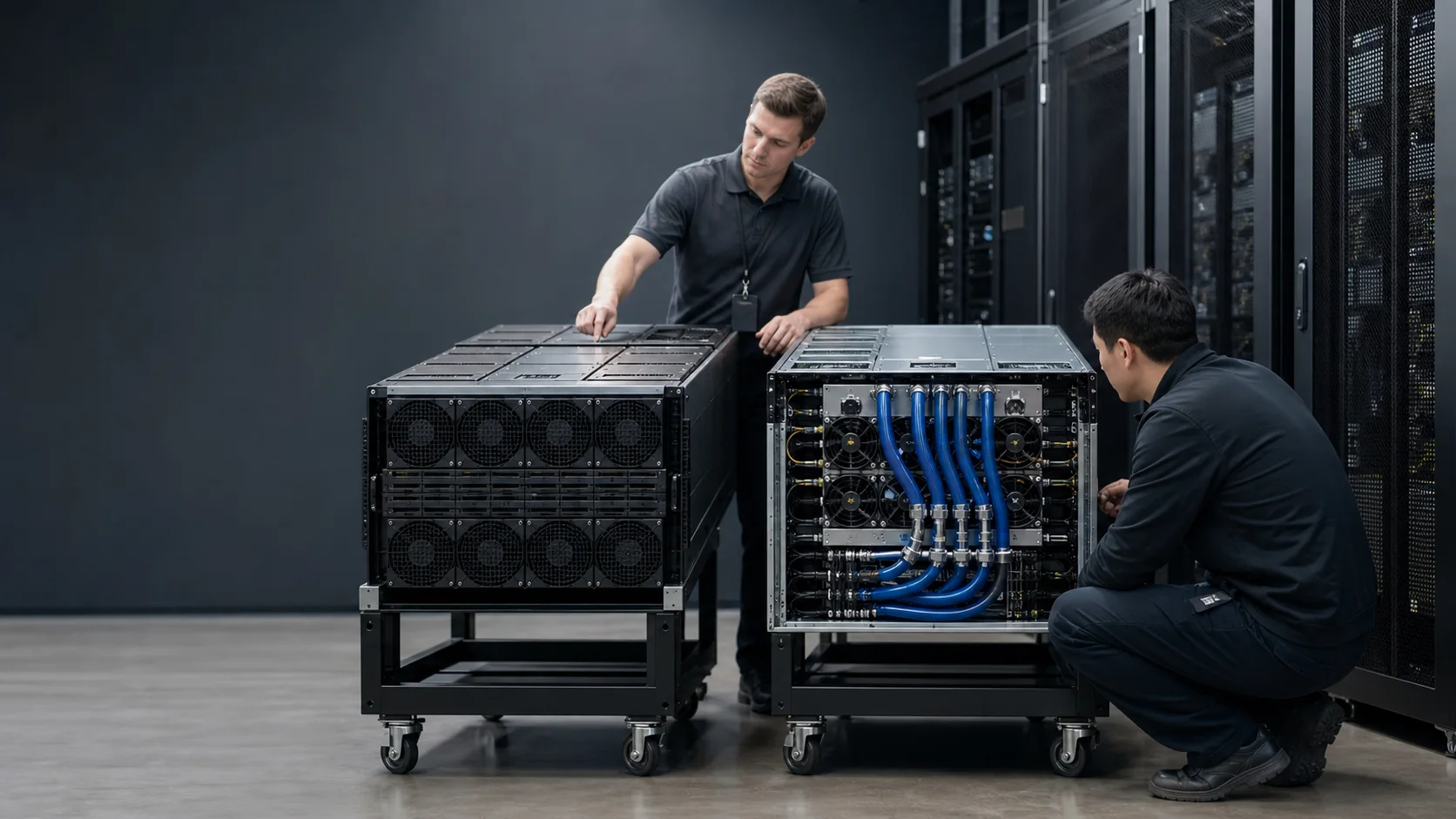
The B200/B300 decision can change at the loading dock. A DGX B200 has an official maximum input power of 14.3 kW in a 10U chassis. An OEM HGX B200 or B300 server has its own figures. The GB300 NVL72 architecture is liquid-cooled and can reach 142 kW for a full rack.
For both proposals, collect:
- Rack units, dimensions, static/rolling weight and service clearances.
- Typical and maximum system and rack power.
- Input voltage, feed, connector and redundancy.
- Airflow and heat output, or liquid inlet/flow/pressure requirements.
- CDU, manifold, water-quality and leak-detection requirements.
- Network, storage and management-rack dependencies.
- Installation, commissioning and maintenance procedures.
Score against the actual site, not an idealized future room. Include schedule and cost for switchgear, busway, PDUs, cooling plant, facility-water systems, structural review and controls integration. If the required facility work is unfunded or cannot complete before the mission date, the more powerful system is not presently deployable.
The high-density GPU rack guide provides a facility-readiness worksheet. Complete it before treating power and cooling as a footnote.
Compare software and operational maturity
List the software baseline that the agency can approve and operate: operating system, driver, CUDA, container platform, orchestration, scheduler, model runtime, monitoring, security agents and backup integration. Confirm that the proposed B200 and B300 systems support those versions or document the migration.
New hardware may require newer drivers, kernels or firmware. In a restricted environment, every dependency needs a transfer, scanning, validation and rollback path. The time to update the software supply chain can exceed the time to rack the server.
Assess operational knowledge. Does the team already manage the selected network fabric, DPU, liquid-cooling system and management stack? Are spare parts and trained field engineers available for the site? Can monitoring export into the agency's approved tooling? Does the support provider reproduce the configuration in a lab?
Require a factory acceptance test that exercises accelerators, fabric, storage, management and cooling together. A power-on test is not evidence of multi-node readiness. Capture firmware and configuration manifests so the accepted baseline can be rebuilt.
Compare availability and acquisition risk
Availability has several layers: announced, orderable from an OEM, allocated to the supplier, supported in the chosen configuration, listed or orderable through the acquisition path, deliverable to the site and installable by the required date. Ask sources to state each layer.
Obtain part numbers, lead times, quote validity, approved substitutions and the date through which the configuration is supported. A proposal that says “B300 or latest equivalent” transfers too much design risk to delivery. Substitution must trigger an engineering, compliance and price review.
Check whether services and facility components are within scope of the selected vehicle or need a separate action. Verify product listing and contract status in the live system; do not rely on a marketing page. The federal contract-vehicle guide explains current GSA MAS IT, SEWP and CIO-CS considerations.
Include supply-chain evidence at the exact BOM level required by the solicitation. TAA applicability and Section 889 representations cannot be inferred from the GPU generation. The server, embedded components, supplier and order terms all matter.
Use a weighted decision matrix
Score both complete proposals on a 0–5 scale and multiply by mission-approved weights:
Dimension — Example weight — Evidence
Workload performance and memory fit
25% — Representative benchmark and sizing model
Operational date
20% — OEM/supplier lead time and site schedule
Facility fit
15% — Power/cooling/site assessment
Software and security baseline
15% — Support matrix and validation plan
Reliability and support
10% — Service plan, spares and repair procedure
Five-year lifecycle cost
10% — Normalized TCO model
Acquisition/supply-chain evidence
5% — Vehicle and clause-specific records
Weights are examples, not a universal answer. A national-security mission may weight assurance and operational control more heavily. A research pilot may weight early access and model capacity. Keep the raw evidence beside every score so the matrix does not become false precision.
Run sensitivity analysis. If B300 wins only when delivery and facility assumptions receive optimistic scores, identify those assumptions as gates. If B200 wins under every reasonable weight, the newer generation may not justify near-term risk.
Consider a phased strategy
The decision does not have to be all B200 or all B300. A phased plan can deploy a B200 environment for current workloads, establish fabric/storage/operations patterns and validate B300 in a smaller test unit before a later capacity award.
To keep the phase useful, design shared interfaces deliberately. Standardize identity, observability, container workflow, data tiers and acceptance methods where possible. Do not assume network optics, rack power or cooling connections will be identical. Preserve option lines for fabric ports, storage capacity, PDUs, CDUs and services without precommitting to an unsupported configuration.
Define the exit criteria for the B300 phase: supported OEM platform, demonstrated workload result, facility acceptance, security baseline, acquisition availability and lifecycle-cost threshold. Review at named dates. “Wait for B300” without gates is not a strategy; it is an indefinite schedule risk.
Where Uniqcli fits
Uniqcli can build two comparable, date-stamped system scenarios around the same workload and site constraints, then identify the engineering and acquisition gates. Review AI and data solutions, integrated AI server racks and the H200/B200/B300 cornerstone comparison, or request a phased B200/B300 scenario.
The goal is not to recommend the newest platform by default. It is to deliver the most capable system the mission can power, cool, secure, acquire, operate and support on the required date.
Technical note: B300 platform and availability details are time-sensitive. Revalidate the exact OEM configuration, NVIDIA support matrix, facility data and acquisition path before publication and award.