
Cat6 vs Cat6A: The Real Cost of a Cabling Refresh, Line by Line
The spec sheet says 10 Gb to 100 meters. The invoice says conduit fill, bend radius and PoE thermal margin. How the Cat6 vs Cat6A choice actually prices out.
By Uniqcli Team · · 7 min read · Updated

Key takeaways
- Cat6A adds an alien-crosstalk spec Cat6 lacks, letting 10GBASE-T run the full 100 meters versus roughly 37-55 meters on installed Cat6.
- Cat6A's larger cable diameter, not its per-foot price, drives the real cost through conduit fill, tray loading, and bend radius.
- Conduit fill scales with diameter squared, so a cable 30% larger in OD can consume about 70% more cross-sectional area, forcing larger pathways.
- IEEE 802.3bt Type 4 PoE (90W) makes bundle heat a code issue under NEC 725.144; TSB-184-A recommends limiting bundle temperature rise.
- A Cat6 plant is defensible where runs stay under about 55 meters; Cat6A pays off in new construction, long 10G runs, and dense PoE closets.
On this page
Buying Guides
The spec table is settled. The estimate is not.
The engineering comparison between Cat6 and Cat6A fits in a table: 250 MHz versus 500 MHz, 55 meters versus 100 meters for 10GBASE-T. The procurement comparison does not. Cat6A cable is physically larger, and that cascades into conduit fill counts, tray loading, bend radius, and sometimes the pathways themselves — the cascade, not the per-foot material delta, is where a refresh budget actually moves. At the same time, 90 W PoE under IEEE 802.3bt has turned bundle heating from a footnote into a code item. This guide walks the decision the way an estimator does: what the standards guarantee, where the money actually sits in an installed channel, and when a Cat6 run at 55 meters is a perfectly defensible answer.
Cat6A characterized bandwidth under ANSI/TIA-568 — double the 250 MHz specified for Cat6
Full 10GBASE-T channel length over Cat6A per IEEE 802.3an-2006
Workable 10GBASE-T reach over installed Cat6, alien-crosstalk dependent, per TIA TSB-155 guidance
Maximum source power of IEEE 802.3bt-2018 Type 4 PoE, delivering 71.3 W at the powered device
What the A actually buys: alien-crosstalk headroom, not just megahertz
ANSI/TIA-568 characterizes Cat6 to 250 MHz and Cat6A to 500 MHz, but the frequency number understates what the A actually buys. The operative addition is an alien-crosstalk specification — limits on noise coupled from neighboring cables in the same bundle — that Cat6 was never designed against. 10GBASE-T, defined in IEEE 802.3an-2006, encodes densely enough that noise from the cable next door becomes the limiting impairment. Cat6A is, in effect, Cat6 re-engineered so the channel still closes with 10 Gb/s running in every adjacent position of the bundle.
That re-engineering is physical. Cat6A constructions use tighter, varied twist rates, thicker jackets, and in many designs internal separators or larger overall geometry to push neighboring pairs apart. Typical outside diameters run around 0.23 inches for Cat6 and commonly 0.26 to 0.35 inches for Cat6A, depending on construction. That diameter — not the megahertz — is the number that follows you through the rest of the estimate, because nearly everything downstream of the reel is sized by cable cross-section.
Distance is where the standards draw the clean line. Over a compliant Cat6A channel, 10GBASE-T runs the full 100 meters. Over Cat6, TIA's TSB-155 guidance puts the workable range at roughly 37 meters in unfavorable alien-crosstalk conditions and up to 55 meters where mitigation is applied — unbundled runs, separated patch-panel positions. Meanwhile IEEE 802.3bz-2016 gives 2.5GBASE-T and 5GBASE-T the full 100 meters over the installed base, with 5 Gb/s specified for Cat6, and gigabit runs 100 meters on either. The question is which of those numbers your endpoints actually need.
Where the money sits: the diameter cascade, not the per-foot delta
On a bill of materials, the visible delta is the cable itself: Cat6A stock costs more per foot than comparable Cat6, and it is tempting to price the decision off the reels. In an installed channel that is the smallest piece of the picture. Labor, pathway capacity, terminations, testing, and firestopping dominate the installed cost of structured cabling, and every one of those lines is sensitive to the physical cable — which is why the diameter cascade matters more than the per-foot delta.
Conduit fill is the cleanest illustration. Fill area scales with the square of diameter, so a cable roughly 30 percent larger in OD consumes about 70 percent more cross-sectional area — and the NEC caps conduit fill at 40 percent for three or more cables. Pathways sized comfortably for a given Cat6 count can come up short for the same count in 6A, which surfaces in the estimate as larger conduit trade sizes, additional sleeves and penetrations, heavier tray loading, and more J-hooks per run. On a refresh that reuses existing pathways, this is frequently the line that decides the category.
Bend radius and termination hardware follow the same logic. Standard practice for four-pair UTP horizontal cable is a minimum bend radius of four times the outside diameter, so a fatter cable needs more room in boxes, at faceplates, and at the panel — dense 48-port terminations get physically harder. Cat6A also requires category-matched jacks and panels to keep the channel rating, and it is heavier per thousand feet, which matters for tray spans and vertical support intervals. Price the channel, not the cable.
PoE++ in bundles: heat is now a code line-item
Power over Ethernet changed the thermal math. IEEE 802.3bt-2018 Type 3 sources up to 60 W at the port, and Type 4 up to 90 W, delivering 71.3 W at the powered device — over all four pairs simultaneously. Current flowing through every pair of every cable in a bundle produces resistive heat, and the cables in the interior of a tightly cinched bundle cannot shed it. Sustained temperature rise erodes insertion-loss margin and, over years, works on the jacket itself.
The codes now say so explicitly. NEC 725.144, introduced in the 2017 cycle, sets ampacity limits by conductor gauge and bundle size for four-pair cabling carrying more than 60 W, with LP-listed cables exempt from the table. TIA's TSB-184-A guidance recommends limiting temperature rise in the bundle — 15 °C is the commonly used planning figure — and steers high-power designs toward larger conductors and smaller bundles. Most Cat6A is built on 23 AWG conductors by default, while Cat6 ships in both 23 and 24 AWG constructions, so verify the datasheet, not just the category marking.
Deployment guidance follows directly. Inventory the worst-case PoE load per closet — Wi-Fi 7 access points, PTZ cameras, LED lighting nodes, powered displays — and design bundle counts to it rather than to tidy aesthetics. Loose-laid or hook-and-loop-dressed bundles run cooler than cinched ones, and spreading high-power runs across tray width helps more than it looks like it should. Where a pathway forces large bundles at Type 4 power, larger-conductor or LP-listed cable stops being an upgrade and becomes the compliance path.
When each category wins — and when a mixed plant is the right answer
Cat6 remains a defensible, standards-clean answer more often than the upgrade reflex suggests. If the floor plate keeps horizontal runs inside roughly 55 meters — common when telecom rooms are reasonably centered — 10GBASE-T is achievable on Cat6 with alien-crosstalk care, and IEEE 802.3bz covers 2.5 and 5 Gb/s to the full 100 meters regardless. For desk drops feeding gigabit endpoints and access points uplinking at 5 Gb/s, a Cat6 plant meets the requirement as written, and the pathway math stays where the building already is.
Cat6A earns its cascade in specific, predictable situations: new construction or any refresh that already reopens pathways, where the marginal conduit and tray sizing is designed in rather than retrofitted; runs that genuinely need 10 Gb/s past 55 meters; closets carrying dense 802.3bt Type 3 and Type 4 loads, where the thermal margin is worth paying for; and plants expected to outlive two or three generations of electronics. The cabling almost always outlasts the switches — the category decision is a bet on the last generation of electronics it will serve, not the first.
Mixed plants are legitimate and increasingly the norm: Cat6A to wireless-drop locations and high-power devices, Cat6 to desks. The procurement discipline is to price both options as complete installed channels — cable, pathway deltas, terminations, testing — from the same estimator, with the pathway assumptions stated. A per-foot comparison will always flatter Cat6; a whole-channel comparison on a building with pathway headroom frequently narrows the gap enough that 6A wins on the ten-year view. The spec table tells you what works; the channel estimate tells you what it costs.
Same run, two grades, plus the panel
Axiom Memory Solutions
Axiom 100FT CAT6 550mhz Patch Cable Molded Boot (Blue)
$42.52In stockAxiom Memory Solutions
Axiom 100FT CAT6A 650mhz Patch Cable Molded Boot (Blue)
$85.43In stockBlack Box
Black Box CAT6 Patch Panel
$614.82*In stock
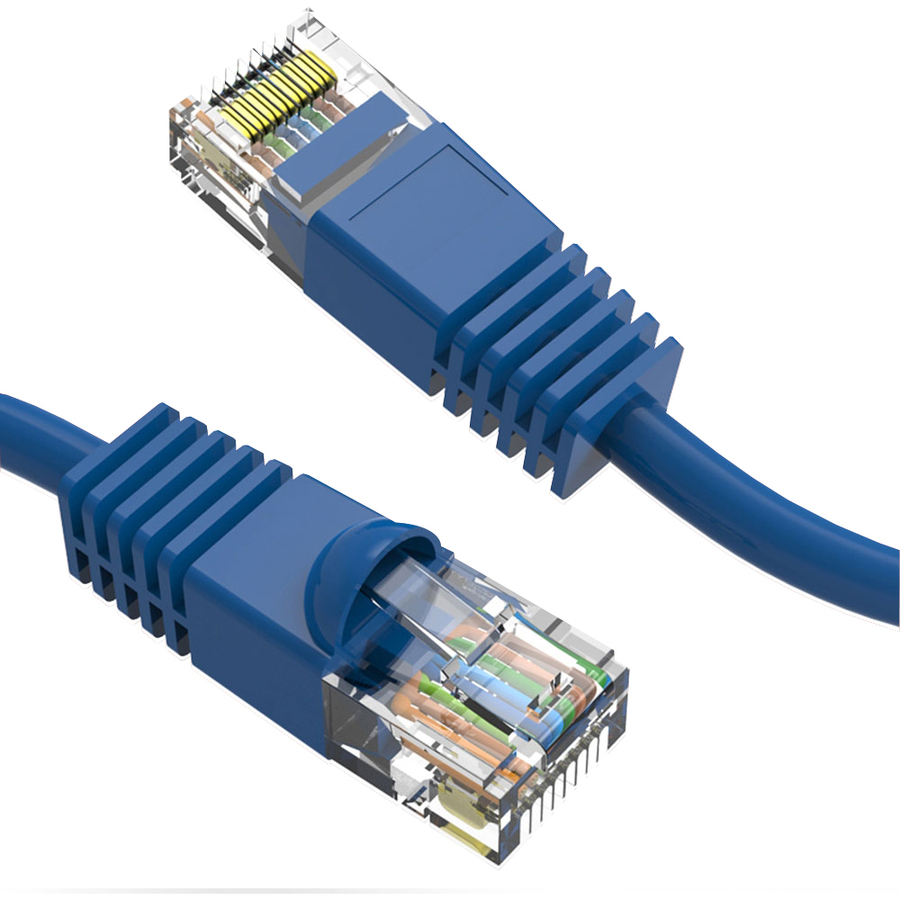
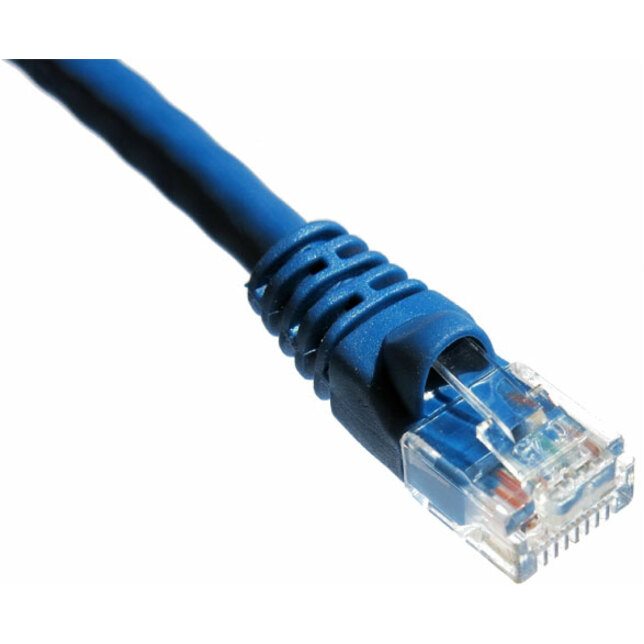
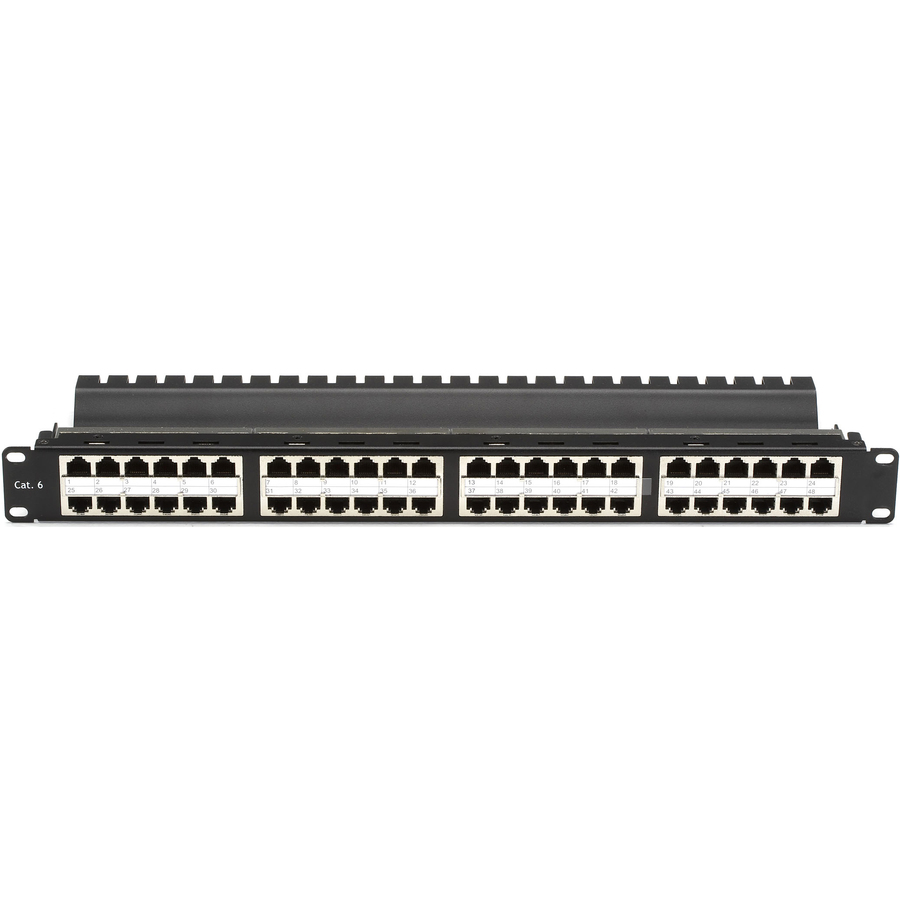
Two 100-foot patch cables from the same maker in the same colour and the same molded-boot construction, one Cat6 and one Cat6A, so the gap between them is as close to a clean grade delta as two catalog rows get — and a feed-through patch panel beside them, because the category decision is a channel decision and the panels and jacks have to be matched to it. Whatever gap you see between the two cables is still the smallest line in the estimate: the conduit, terminations and testing above it are what actually move. Prices and availability are read from the catalog when this page renders.
Keep reading
Related comparisons & shopping
Common questions
Can Cat6 carry 10 Gb Ethernet at all?
Yes, with limits. IEEE 802.3an specifies 10GBASE-T for 100 meters only on Cat6A. Over installed Cat6, TIA TSB-155 guidance supports roughly 37 meters in unfavorable alien-crosstalk conditions and up to 55 meters with mitigation such as unbundling and separated patch-panel positions. Short, managed runs are workable; a full-length horizontal channel is not.
Do Wi-Fi 6E or Wi-Fi 7 access points require Cat6A?
Not strictly. Most current access points uplink at 2.5 or 5 Gb/s, which IEEE 802.3bz carries 100 meters over Cat6. Cat6A adds 10 Gb/s headroom and thermal margin for 802.3bt power, which is why many designs pull one or two 6A drops per AP location even in an otherwise Cat6 building.
Does Cat6A have to be shielded?
No. Cat6A is defined by performance — including alien-crosstalk limits — not by shielding. Unshielded (UTP) and shielded (F/UTP) Cat6A constructions both exist and both certify. Shielding is a separate decision driven by the EMI environment and grounding practice, with its own installation implications.
How much more does a Cat6A refresh actually cost?
There is no honest single percentage. The per-foot material delta is real but small against installed-channel cost; the swing factors are pathway headroom, bundle sizes, termination counts, and whether conduit or tray must grow. Price both categories as complete installed channels for your specific building — that estimate, not a reel price, is the comparison.
Spec it with a human
Send us the part numbers — we check current availability and lead time, verify TAA on request, and come back with a quote.